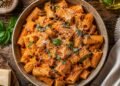


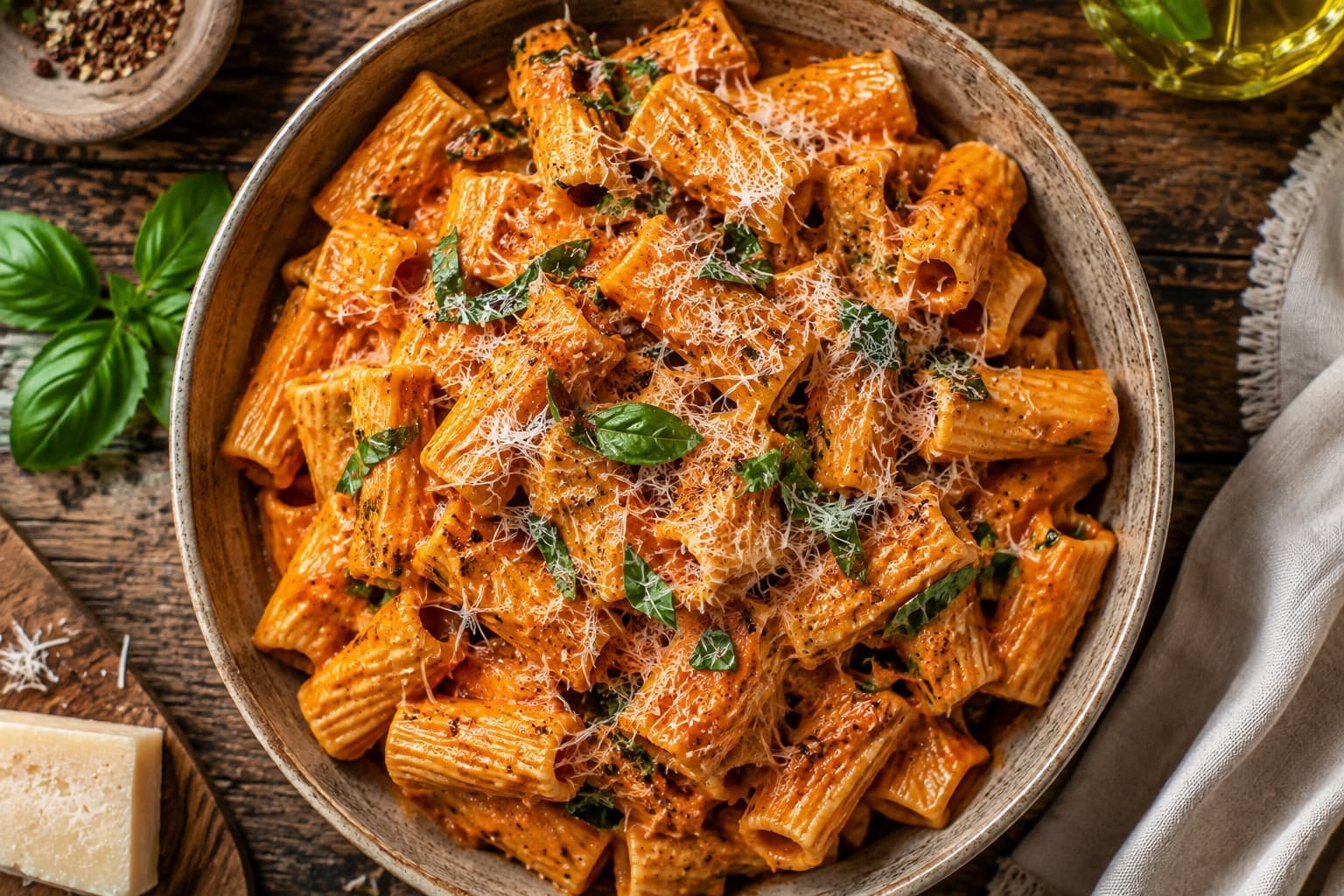
This dish sits at the intersection of two techniques that most home cooks execute separately and badly: building a concentrated tomato base through caramelization, and finishing pasta in its sauce to form a starch-stabilized emulsion. Get both right and you produce a sauce that clings to every ridge of the pasta with a texture closer to velvet than to cream soup. Get either wrong and you get pasta sitting in a pink puddle.
The 20-minute timeline is not a compromise. Long-simmered sauces build depth through slow water loss; this one reaches comparable intensity in two minutes by frying tomato paste instead of reducing crushed tomatoes — a different mechanism, and a better fit for a dairy sauce, since prolonged simmering with cream drives off the aromatics that keep it tasting fresh.
| Prep Time | Cook Time | Total Time | Serves |
|---|---|---|---|
| 5 minutes | 15 minutes | 20 minutes | 4 people |
The Technique Behind It
Two physical processes govern this recipe. The first is browning — Maillard and caramelization together — in tomato paste fried in fat. Paste is roughly 75 percent water even concentrated; frying drives that off and puts its sugars and free amino acids in direct contact with hot oil. Within 90 seconds at medium heat it shifts from bright brick red to rust brown, and the flavor moves from sharp and metallic to sweet and savory. It is the same reaction that browns meat, and the largest single source of depth here.
The second is emulsification stabilized by starch. Pasta water carries dissolved amylose and amylopectin leached from the semolina, and those molecules hold fat droplets suspended in water instead of letting them separate. Finishing the pasta in the pan with a measured amount of that water lets agitation disperse the fat while the starch keeps it dispersed. Italian kitchens call this mantecatura; it is the difference between sauce that coats and sauce that pools.
A third factor constrains the recipe rather than driving it: acid-induced protein coagulation. Tomatoes sit at a pH of roughly 4.2 to 4.4. Casein, the dominant protein in dairy, aggregates and separates near its isoelectric point of pH 4.6. This is why creamy tomato sauces curdle — and why the fat content of the dairy you choose is not a matter of richness but of structural stability.
Ingredients
- 12 ounces rigatoni or penne rigate — Ridged tubes for mechanical reasons, not aesthetic ones: the ridges give the emulsion surface to grip and the hollow interior traps sauce. Smooth penne lisce sheds it.
- 6 tablespoons tomato paste — The flavor engine. Tube paste beats canned: more concentrated, cleaner flavor, and no leftover half-can oxidizing within four days.
- ¾ cup heavy cream (36% butterfat) — Not half-and-half, not whole milk. At 36 percent fat the casein micelles are shielded well enough to resist acid aggregation. Half-and-half (12%) curdles against this much tomato paste about half the time; whole milk (3.5%) almost always does.
- 3 tablespoons extra-virgin olive oil — The frying medium for the paste and part of the emulsion’s fat phase.
- 4 garlic cloves, thinly sliced — Sliced rather than minced. Minced garlic’s high surface area scorches before the tomato paste finishes browning, and scorched garlic contributes bitterness that cream amplifies rather than masks.
- 1 medium shallot, finely diced (about ⅓ cup) — Not onion: its lower water content softens it in 3 minutes instead of 8.
- ¾ teaspoon red pepper flakes — Capsaicin is fat-soluble, so the heat distributes evenly through cream and reads as warmth, not bite.
- 2 ounces Parmigiano-Reggiano, finely grated (about ¾ cup) — Contributes glutamates for savory depth and, critically, additional emulsifying protein. Grate it yourself. Pre-grated cheese is coated with cellulose or potato starch to prevent caking, and those anti-caking agents produce a grainy sauce.
- 1½ teaspoons kosher salt for the pasta water, plus more to finish
- 1½ tablespoons cold unsalted butter — Added off heat at the end. Butter’s milk solids act as an additional emulsifier and add gloss that oil alone does not produce.
- Fresh basil, about 12 leaves, torn — Added off heat. Basil’s aromatic compounds are volatile and largely lost above 160°F.
Substitutions and what they cost: Crushed tomatoes can replace the paste, but you need 1½ cups plus roughly 12 minutes of reduction, and you lose the browned notes — the sauce reads bright and acidic rather than deep. Coconut cream (about 24% fat) holds against the acid but brings a sweetness that fights the shallot. Pecorino Romano works in place of Parmigiano; it is saltier and more acidic, so cut the finishing salt.
How to Make It
- Bring 3 quarts of water to a rolling boil and add 1½ teaspoons kosher salt. This is deliberately less water than the package recommends: the smaller volume raises starch concentration to roughly 1.5 to 2 percent by weight instead of under 1 percent, which is your emulsifying power later.
- While the water heats, warm the olive oil in a 12-inch skillet over medium and add the shallot. Cook 2 to 3 minutes until translucent and beginning to soften at the edges, stirring occasionally. You want no color on the shallot at this stage; browning it now makes it taste harsh under the cream.
- Add the sliced garlic and pepper flakes. Cook 45 seconds, until the garlic is fragrant and just beginning to turn pale gold at the edges. Move immediately to the next step — garlic goes from gold to bitter in under 30 seconds at this temperature.
- Add the tomato paste and spread it across the pan bottom with a wooden spoon. Cook 90 seconds to 2 minutes, stirring and scraping continuously. Watch for the color change from bright red to a darker rust brown, and for the paste to begin sticking to the pan and releasing oil at the edges. Both are signals that the water has driven off and browning has begun. If it starts to smell acrid rather than sweet, the heat is too high — pull the pan off for 15 seconds and lower the burner.
- Start the pasta. Add it to the boiling water and cook 2 minutes short of the package’s al dente time — for most rigatoni that means 9 minutes rather than 11. The pasta will finish cooking in the sauce, absorbing sauce rather than water during those final minutes. This is the point of the technique.
- Drop the heat to low and pour in the cream, whisking as it goes. Cream added above roughly 200°F meets the tomato acid at a temperature that accelerates casein aggregation, which is why the heat comes down first. Whisk about 30 seconds to a uniform pale terracotta, then hold at a bare simmer while the pasta finishes.
- Reserve 1½ cups of pasta water before draining. Do this with a measuring cup or mug — not by tipping the pot. You will use most of it, and running short mid-emulsion is the most common self-inflicted failure in this recipe.
- Transfer the drained pasta directly into the skillet along with ¾ cup of the reserved water. Raise the heat to medium and stir constantly for 2 to 3 minutes. The sauce will look alarmingly thin at first, then visibly tighten as the starch hydrates and the pasta absorbs liquid. This is normal and expected.
- Remove the pan from the heat. Add the grated Parmigiano and cold butter, stirring vigorously until both disappear into the sauce, about 60 seconds. The pan must be off heat and below approximately 175°F before the cheese goes in. Above that, the casein and calcium in Parmigiano contract into rubbery strings and the sauce turns grainy — irreversibly.
- Adjust consistency with the remaining pasta water, adding it 2 tablespoons at a time until the sauce coats the pasta and leaves a clear trail when you drag a spoon across the pan bottom. Taste and add salt. Fold in the torn basil and serve immediately — the emulsion is at its best within about 90 seconds of finishing.
Mastering the Emulsion
Frying the paste is a skill you learn in one attempt. The emulsion takes several, because it requires reading a moving target rather than following a number.
You are managing three variables: starch-laden water, fat, and agitation. Too much water drops the starch below the threshold that holds fat in suspension and the sauce separates on the plate within a minute. Too little and the starch over-thickens into clumps. The right amount is not fixed — it depends on how starchy your particular pot was, which varies with pasta brand and how hard it boiled. That is why you add water in stages and keep the pan moving: agitation shears the fat into droplets small enough to stay suspended, and a pan left still while you hunt for the cheese separates even with correct ratios.
The reliable test: drag a spoon across the pan bottom. Sauce that closes over the track immediately is too thin — keep cooking. A track holding defined edges means too thick — add water. A track that fills in slowly over about two seconds is right. The instinct to build is tactile: a stable emulsion pushes back against the spoon with a faint heaviness, while a broken one moves like water. Feel the difference twice and you stop needing the test.
Troubleshooting
The sauce curdled into visible white specks. Cause: the dairy fat percentage was too low for the acid load, or the cream went in over high heat. Correction: remove from heat immediately and whisk in 2 tablespoons of cold cream — the added fat and the temperature drop re-stabilize a mildly broken sauce. Prevention: 36 percent cream, added over low heat, every time.
Thin sauce pooling at the bottom of the bowl. Cause: insufficient starch — too much cooking water, or tap water used instead of pasta water. Correction: keep stirring over medium heat another 60 to 90 seconds to concentrate it. Do not reach for flour or cornstarch; both produce a dull, pasty texture detectable in one bite.
The sauce is grainy or stringy. Cause: cheese added above 175°F, or pre-grated cheese with anti-caking starch. This one is not fixable once it happens; the protein structure has already contracted. Prevention: pan off heat, cheese grated fresh.
Flat, metallic flavor. Cause: under-fried tomato paste, which keeps the tinny taste of raw concentrate. A pinch of sugar masks it slightly; nothing fixes it properly. Wait for rust brown, not just heated-through red.
Soft pasta, still-thin sauce. Cause: the pasta hit full al dente in the water, so it entered the pan with nothing left to absorb and no starch left to give. Not correctable. Pull it 2 minutes early.
Acrid or bitter sauce. Cause: scorched garlic in step 3, or paste held too long over high heat. Burnt aromatics cannot be removed — start the base again, which costs 3 minutes.
Variations Grounded in the Method
Vodka-free version of the classic pink sauce profile. The traditional recipe’s alcohol is credited with releasing tomato aromatics and aiding emulsification. Replace the function rather than the ingredient: add 2 tablespoons of fresh lemon juice at the very end, off heat. The acid brightens the aromatics and the additional water content thins the sauce slightly, so hold back 2 tablespoons of pasta water to compensate.
Roasted red pepper. Blend ½ cup jarred roasted red peppers into a smooth purée and add it with the cream. Peppers contribute pectin, which raises the sauce’s viscosity independent of starch — meaning this variation is measurably more forgiving of an imprecise water ratio. It is the version to make while you are still learning the emulsion.
‘Nduja or spicy sausage. Render 3 ounces of crumbled spicy sausage in the pan before the shallot and proceed in the rendered fat. The added animal fat increases the total fat phase, so reduce the olive oil to 1 tablespoon or the emulsion will carry more fat than the available starch can stabilize.
Mascarpone in place of cream. Use ⅔ cup mascarpone (roughly 44% fat) thinned with 3 tablespoons of pasta water. The higher fat content makes curdling essentially impossible and produces a denser, rounder sauce. The trade-off is real: it mutes the tomato’s brightness noticeably, so increase the paste to 7 tablespoons.
Serving and Pairing
The sauce is rich, mildly sweet from the caramelized paste, and lower in acid than a standard marinara because the cream buffers it. The plate needs acidity and bitterness or it reads heavy by the fourth bite. A raw bitter green is the most effective counterweight — radicchio or escarole dressed with lemon, olive oil, and salt, since bitterness resets the palate in a way sweeter greens do not. Arugula works and is easier to find.
Skip bread — this is already starch coated in fat, and bread adds volume without contrast. For a second element, roast broccolini at 450°F until the edges char; the bitter char does the same work as the greens. Sparkling water with lemon earns its place at the table too: carbonation physically disrupts fat coating on the palate.
Storage, Reheating, and What Changes
This dish is meaningfully worse the next day, and it is honest to say so. Two things happen in the refrigerator. The pasta continues absorbing sauce, so a sauce that coated properly at dinner is largely inside the pasta by morning. And the emulsion breaks as butterfat solidifies below about 55°F, separating into fat and watery liquid.
Both are partially reversible. Store in an airtight container up to 3 days. Reheat in a skillet over low heat with 3 to 4 tablespoons of water or milk per portion, stirring constantly for about 3 minutes. The agitation and added liquid re-form the emulsion, though not to its original body — the starch has retrograded, meaning its molecules have recrystallized into a firmer structure that will not fully return to its dispersed state.
A microwave heats unevenly enough that fat separates before the center warms; at 50 percent power, stirring every 45 seconds, it is survivable. Do not freeze it — ice crystals rupture the emulsion permanently.
Approximate Nutrition Per Serving
| Calories | Protein | Carbs | Fat | Fiber |
|---|---|---|---|---|
| 718 kcal | 21 g | 71 g | 39 g | 5 g |
All values are approximate estimates provided for informational purposes only. Actual figures vary with pasta brand, cream fat percentage, and portion size.
Closing
Both techniques here transfer well beyond the dish. Frying tomato paste for depth applies to any braise, stew, or ragù you will make. Finishing pasta in its own sauce with reserved water underpins most of the Italian repertoire — cacio e pepe, carbonara, and aglio e olio are the same emulsion problem with different fats. Learn to read the spoon track and you have a diagnostic tool, not a recipe.