


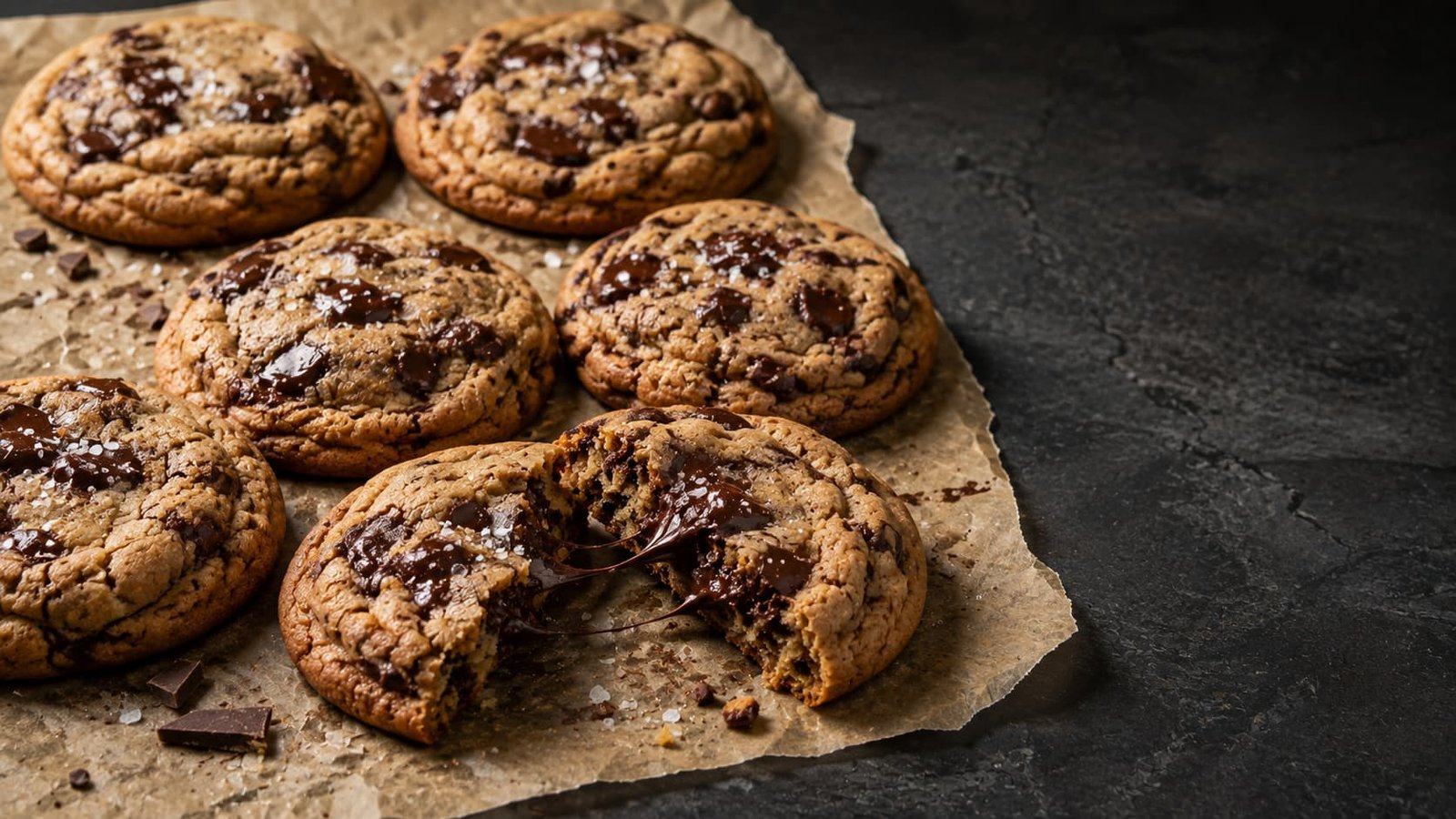
Chew is not a matter of luck or of pulling cookies from the oven at the right moment. It is a formulation outcome, and it is controlled by five variables: the ratio of brown sugar to white, the state of the fat when it enters the dough, the protein content of the flour, the proportion of egg yolk to egg white, and how long the dough hydrates before it bakes.
Adjust those five and the same basic recipe moves anywhere from thin and brittle to soft and cakey. The version below sits deliberately at the chewy end — dense, slightly underbaked at the center, with a crisp rim and a middle that pulls apart in strands rather than crumbling.
Nothing here is difficult. But the dough rests for 24 hours, and that is not negotiable if you want the result the title promises.
| Prep Time | Rest Time | Bake Time | Makes |
|---|---|---|---|
| 20 minutes | 24 hours | 10 minutes | 16 cookies |
The Chemistry of Chew
Chewiness comes down to moisture that stays put and gluten with something to hold onto. Brown sugar handles the first job: its molasses carries invert sugars — glucose and fructose — that are hygroscopic, binding water and resisting giving it up during baking and after. White sugar does not. A dough weighted toward brown holds moisture for days, and that retained water is what you perceive as chew.
Gluten handles the second. Bread flour runs 12 to 13 percent protein against all-purpose flour’s 10 to 11, and that extra protein builds a stronger network — enough structure to resist the bite rather than fracture under it. It is the largest lever available, and this one swap changes the texture more than any other on the list.
The fat’s state at mixing decides the rest. Creaming softened butter with sugar whips air into the mixture, and those air cells expand in the oven into a light, cakey crumb. Melting the butter instead introduces no air at all, so the cookie stays dense. This is why creamed butter and chewy cookies are mutually exclusive, and why most recipes that call for creaming produce something softer and more cake-like than their titles claim.
Ingredients
- 285 grams bread flour (about 2¼ cups) — Weigh it. Cookie dough is a low-hydration system and a 20-gram flour error shifts the texture visibly. All-purpose flour substitutes directly and produces a softer, more tender cookie with noticeably less pull; cake flour at 7 to 8 percent protein produces something closer to a soft cookie-cake and is the wrong choice here.
- 170 grams unsalted butter, melted and cooled to warm (12 tablespoons) — Melt it, then let it sit until it is no longer hot to the touch, around 90°F. Butter above about 120°F starts cooking the egg proteins on contact.
- 200 grams dark brown sugar (1 cup packed) and 65 grams granulated sugar (⅓ cup) — A 3:1 ratio favoring brown. Dark brown over light: it carries roughly twice the molasses, which means more invert sugar and more moisture retention. Reversing this ratio gives you a crisp cookie, and that is a legitimate cookie — just not this one.
- 1 large egg plus 1 additional yolk — The extra yolk does precise work: it is about 50 percent water, 30 percent fat, and carries lecithin, an emulsifier that binds the two into a smooth dough. Egg white is nearly 90 percent water with albumin proteins that set firm and dry, so a second whole egg pushes the cookie cakey and slightly rubbery.
- 1 teaspoon baking soda — Soda, not powder, and not both. Sodium bicarbonate raises the dough’s pH, and alkaline conditions accelerate the Maillard reaction — so a soda-leavened cookie browns deeper and develops more roasted flavor at the same temperature. It also weakens gluten slightly, which encourages the spread this cookie needs.
- 1¼ teaspoons kosher salt, plus flaky salt for finishing
- 2 teaspoons vanilla extract
- 250 grams dark chocolate (68 to 72%), chopped into rough pieces — Chop a bar rather than using chips. Chocolate chips are formulated with reduced cocoa butter and added stabilizers specifically so they hold their shape under oven heat. Chopped bar chocolate melts and smears into thin pools and layers through the dough, and the irregular pieces — from shards to chunks — give you a different chocolate experience in every bite.
Method
- Whisk the melted butter with both sugars for 45 seconds, until the mixture is smooth, glossy, and the color of wet sand. You are dissolving the sugar into the fat, not aerating it — the mixture should look dense rather than fluffy. If it looks pale and airy, the butter was too cool and partially solid.
- Add the egg, the extra yolk, and the vanilla, and whisk hard for 60 seconds. This is the one place vigorous mixing helps. The lecithin in the yolks needs mechanical agitation to emulsify the fat and water into a stable system, and you will see the change — the dough goes from slightly broken and greasy-looking to uniformly smooth and slightly lighter in color.
- Whisk the flour, baking soda, and kosher salt together separately, then add to the wet mixture. Whisking the soda through the flour first prevents concentrated pockets, which bake into bitter, soapy-tasting spots with a distinctly darker crumb.
- Fold with a spatula until the last streaks of dry flour just disappear — no more. Roughly 15 to 20 folds. Overworking develops gluten beyond what you want and the cookies bake up tough rather than chewy, which are different things: chew is elastic resistance, toughness is dryness and effort.
- Fold in the chopped chocolate, about 8 more folds. Reserve a small handful to press onto the tops before baking.
- Cover the bowl and refrigerate 24 hours. Minimum. Details in the next section, but briefly: the flour is still hydrating, and enzymes are breaking starch into simple sugars that brown better.
- Heat the oven to 375°F with a rack in the upper-middle position and line two sheet pans with parchment. Three-seventy-five rather than 350: the higher heat sets the outer edge faster while the center is still rising, which is exactly the crisp-rim-soft-middle contrast this cookie depends on.
- Portion the dough into 60-gram balls — about 3 tablespoons each, roughly golf-ball size. Do not flatten them. Size matters mechanically here: a large ball creates a steep thermal gradient between edge and center, so the outside crisps while the middle stays underdone. Small cookies bake through evenly and come out uniformly crisp.
- Bake 8 cookies per sheet, one sheet at a time, for 9 to 11 minutes. Pull them when the edges are set and lightly browned, the ring just inside the edge looks dry, and the center still looks puffed and visibly underbaked. That center will not look done. Trust it.
- Rest on the hot sheet for 5 minutes, then transfer to a rack. Carryover heat from the pan finishes the centers — this is where the underbaked middle becomes chewy rather than raw. Moving them off immediately leaves the center gummy; leaving them on for 10 minutes overcooks it.
- Sprinkle flaky salt while they are still hot, within the first minute, so it adheres to the surface rather than sitting loose on it.
The Two Levers That Decide the Outcome
The rest and the pull are where this recipe is won or lost. Both are simple to execute and easy to talk yourself out of.
The 24-hour rest accomplishes two distinct things. First, hydration: flour absorbs liquid slowly, and in a stiff dough full particles take many hours to fully wet. A rested dough is more cohesive, spreads more predictably, and bakes into a more even crumb. Second, enzymatic breakdown — amylase enzymes present in the flour cleave starch molecules into simpler sugars over time, and those sugars caramelize and participate in Maillard browning far more readily. A dough baked immediately and the same dough baked at 24 hours come out visibly different in color and measurably different in flavor depth.
Thirty-six to seventy-two hours is better still, with diminishing returns past three days. Under 12 hours you get most of the hydration benefit and almost none of the flavor benefit.
Pulling them underbaked is the harder discipline. The visual target is a center that has puffed and lost its raw shine but still looks soft and slightly domed, while the outer third has flattened and browned. If you own an instant-read thermometer, the center reads about 175°F at the correct moment — a fully baked cookie center reads closer to 205°F and is no longer chewy.
The instinct to build is watching the edge rather than the middle: the moment the ring just inside the rim stops looking wet, the cookie is done regardless of the center. Two batches of watching that ring and the timer becomes optional.
Troubleshooting
The cookies spread thin and flat. Cause: butter too warm when the dough was portioned, or no chilling at all. Warm fat liquefies before the structure sets and the dough flows outward. Correction: chill the portioned balls 20 minutes before baking. If the whole batch has already spread, reduce the oven to 350°F and add a tablespoon of flour to the remaining dough.
They came out puffy and cakey. Cause: creamed butter instead of melted, or baking powder used alongside the soda. Both introduce lift this cookie is designed to avoid. No correction after baking; the formulation was wrong.
Tough and dry rather than chewy. Cause: overmixed after the flour went in, or overbaked by two or three minutes. Both are common and both are avoidable — 15 to 20 folds, and pull at the visual cue rather than at a time.
Bitter or soapy patches. Cause: baking soda that was not distributed through the flour. Whisk the dry ingredients thoroughly before combining.
Pale, blond cookies with little flavor. Cause: no rest, oven too cool, or light brown sugar instead of dark. Alkaline pH and available simple sugars drive browning, and skipping the rest removes the second. Rest the dough and check your oven with a thermometer — home ovens run 25°F off their dial more often than not.
The chocolate sank to the bottom. Cause: pieces chopped too large and heavy for the dough’s viscosity. Keep the largest pieces to roughly ½ inch, and press the reserved chocolate onto the tops of the balls before baking.
Variations With a Technical Basis
Brown the butter. Cook the butter until the milk solids turn amber and it smells of toasted hazelnut, about 5 minutes, then add 2 tablespoons of water back to the pan to replace what evaporated. That water matters — browning drives off roughly 15 percent of butter’s weight as steam, and without replacing it the dough is measurably drier and the cookies spread less. The flavor gain is substantial.
Pan-banging for ridged, dense cookies. At minutes 6, 8, and 10, lift the sheet two inches and drop it flat onto the oven rack. Each impact collapses the risen center and forces it outward, creating concentric ripples and a denser, chewier interior. This works because it repeatedly deflates the structure before it sets — a mechanical intervention, not a formulation one.
Increase the rest to 72 hours. The same dough at three days browns deeper and tastes distinctly more caramelized and complex. Portion the balls before chilling so the dough is manageable, and note that spread decreases slightly as the dough dries in the refrigerator.
Rye flour for 20 percent of the total. Replace 57 grams of the bread flour with dark rye. Rye contributes pentosans — soluble fibers that bind water aggressively — which increases chew, and its own malty, slightly sour flavor sits well against dark chocolate. Do not exceed 25 percent or the gluten network weakens too far and the cookies crumble.
Corn syrup for pronounced chew. Substitute 30 grams of light corn syrup for 30 grams of the granulated sugar. Corn syrup is nearly pure glucose, an invert sugar that resists crystallization and holds water even more effectively than molasses. The cookies stay soft noticeably longer, at the cost of a slightly softer bite.
Serving and Pairing
Serve them 15 to 20 minutes out of the oven. At that point the chocolate has thickened from liquid to soft without fully setting, which is the best textural moment the cookie has — fully cooled, the chocolate firms and the contrast becomes a snap rather than a smear.
The pairing logic is acid and bitterness against sugar and fat. Black coffee is the standard answer and it is right — its chlorogenic acids and roasted bitterness clear the palate between bites. Cold whole milk works on a different principle, coating the palate and muting the chocolate’s astringency rather than cutting sweetness, which is why milk makes cookies taste sweeter and coffee makes them taste more chocolatey.
Flaky salt on top is not decoration. Sodium suppresses bitterness perception at the receptor level, so salted 70 percent chocolate reads rounder and more intensely of chocolate than the same chocolate unsalted.
If you are serving these as a plated dessert, warm one cookie for 8 seconds in a microwave and set it against crème fraîche. The lactic acidity does the same work as the coffee.
Storage
Store cooled cookies airtight at room temperature up to 4 days. What degrades is not moisture loss to the air but starch retrogradation — gelatinized starch recrystallizing into a firmer structure, the same process that stales bread. The brown sugar’s invert sugars slow it considerably, which is why this formulation holds its chew longer than a crisp recipe would.
A slice of sandwich bread in the container genuinely works. The bread has higher water activity than the cookies and gives up moisture to the surrounding air until the two equilibrate. Replace it when it goes hard, roughly every two days.
Eight seconds in a microwave reverses retrogradation temporarily — heat above about 140°F re-melts the recrystallized starch and the cookie is chewy again for several minutes before firming as it cools. This works repeatedly and is the correct way to serve a day-old cookie.
The dough freezes better than the cookies do. Freeze portioned 60-gram balls on a tray, then bag them; they hold 3 months. Bake from frozen at 375°F, adding 2 minutes. Baked cookies frozen and thawed lose their crisp rim permanently, because the moisture redistributes evenly through the cookie during thawing.
Approximate Nutrition Per Cookie
| Calories | Protein | Carbs | Fat | Fiber |
|---|---|---|---|---|
| 328 kcal | 5 g | 40 g | 17 g | 2 g |
All values are approximate estimates provided for informational purposes only, based on 16 cookies of 60 grams each. Actual figures vary with chocolate percentage and portion size.
Closing
What this recipe teaches is that texture in baking is a formulation decision rather than a matter of skill. Brown sugar for water retention, bread flour for gluten strength, melted butter for density, extra yolk for emulsification, and time for hydration and enzymatic browning — each one is a dial, and knowing which direction each turns is what lets you fix a cookie recipe instead of abandoning it.
Rest the dough a full day and pull them looking underdone. Those two choices account for most of the distance between a competent cookie and this one.