

The single most common complaint about kitchen island pendants has nothing to do with style, finish, or price — it is that they hang too low, sitting directly in the sightline of anyone seated at the island, turning a beautiful fixture into something everyone quietly leans around to see past each other. Getting the hanging height wrong is the one mistake that undoes an otherwise perfectly chosen pendant.
This guide covers choosing and specifying island pendants correctly — sizing, spacing, and height — with actual installation left to a licensed electrician, since pendant fixtures are hardwired and connecting them is outside the scope of what this guide addresses. Getting the specification right before that call is what makes the installation itself a one-time job rather than a return visit.
Why Proportion and Sightline Matter More Than Style
An island pendant does two jobs simultaneously that a lamp or an overhead fixture elsewhere in the home does not: it provides genuine task lighting for the counter surface below, and it sits directly within the eye level of anyone seated at the island, which means its placement affects conversation and sightlines in a way most other fixtures never have to account for.
This dual role is why pendant selection genuinely differs from choosing decorative lighting elsewhere in a home — a fixture that looks perfect in isolation can still fail the room if its height blocks the exact sightline people use most, across the island toward whoever is cooking or seated opposite.
What to Consider When Choosing Pendants
- Island length, which determines both how many pendants suit the space and how much combined width they should occupy.
- Ceiling height, since a low ceiling limits how much drop is available before a pendant genuinely interferes with sightlines, while a taller ceiling allows more visual breathing room above the fixture.
- Stool or chair height, since seated eye level, not standing eye level, is the sightline that actually matters for the glare and visibility concerns this guide addresses.
- Shade material and openness, since a fully open shade produces more direct glare at eye level than a shade with a diffusing element, regardless of how the two compare in raw brightness.
How to Choose and Position Pendants, Step by Step
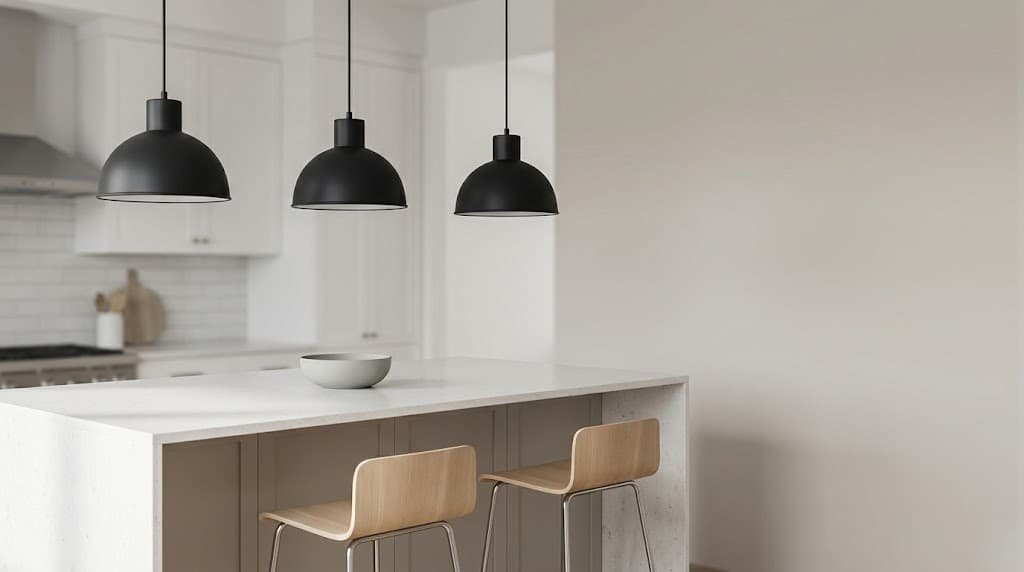
- Measure the island’s total length and divide by three as a starting point for the combined width your pendants should occupy — three pendants of roughly equal diameter spaced across that width is a reliable proportion for a standard island, though the exact count depends on your specific length.
- Choose an odd number of pendants — one, three, or five — for a symmetric, centered arrangement, since an odd count centers naturally on the island’s midpoint in a way an even count requires more careful spacing to achieve the same balance.
- Space multiple pendants so the gap between them is roughly equal to each pendant’s own diameter, which keeps the grouping visually connected rather than either crowded together or scattered too far apart to read as one composition.
- Sit on the actual stools that will be used at the island, and have someone hold a pendant or a similarly sized object at a proposed height, checking specifically whether it sits within your direct sightline across the island. This physical test matters more than any fixed measurement, since ceiling height and stool height vary enough between homes that a universal number does not reliably work everywhere.
- As a general starting point before the sightline test, hang the bottom of the pendant 30 to 36 inches above the island’s counter surface, then adjust based on what the physical sightline test in the previous step actually reveals for your specific stools and ceiling.
- Confirm final placement and wiring with a licensed electrician, who will handle the actual hardwired installation and can advise on any adjustment needed for your home’s specific ceiling structure and existing wiring location.
The Test That Actually Decides This
The seated sightline test from step four matters more than any published height guideline, because published guidelines assume average ceiling height and average stool height, and most kitchens deviate from at least one of those averages enough to make the generic number wrong for that specific space.
A pendant hung at the textbook 30 inches above the counter in a kitchen with unusually tall stools sits noticeably lower relative to seated eye level than the same measurement would in a kitchen with standard-height stools, and the textbook number has no way of accounting for that difference. The physical test — sitting at the actual stools and holding a fixture-sized object at the proposed height — catches this immediately in a way a tape measure alone cannot. It also reveals whether a pendant blocks the sightline toward a specific spot, like the stove or a window, that the tape measure alone would never flag.
This is worth doing before finalizing an order, not after installation, since adjusting a hardwired pendant’s height after the fact means calling an electrician back for work that fifteen minutes of testing beforehand would have avoided entirely.
Practical Notes
A metal or solid shade throws light more directly downward onto the counter surface, which suits food preparation, while a glass or fabric shade diffuses light more broadly across the room, which suits an island used more for casual dining and conversation than heavy prep work.
Matching pendant finish to other metal fixtures in the kitchen — faucet, cabinet hardware — creates cohesion, though a deliberate contrast, one warm metal against otherwise cool-toned hardware, can also read as intentional rather than mismatched if it is the only contrasting element in the room rather than one of several competing finishes.
Dimmable pendants, confirmed compatible with the specific bulb and any existing dimmer switch before purchase, let the same fixture serve both bright task lighting during food prep and softer ambient light during a meal.
Common Mistakes to Avoid
Hanging pendants too low without testing against actual seated sightlines is the most common and most consequential mistake, covered in depth above — it is the single change most likely to require a costly redo after installation is already complete.
Choosing pendant size based on the fixture’s appearance in a showroom rather than its proportion to the actual island length is the second common mistake — a pendant that looks appropriately scaled next to other showroom fixtures can read as either too small or overwhelming once placed above an island with genuinely different proportions.
Selecting a fully open, glare-producing shade for an island used heavily for reading or close work at the counter is the third — an unshaded or minimally shaded bulb positioned directly at eye level produces a specific, uncomfortable kind of glare that a diffusing shade avoids entirely.
Adapting for an Unusual Island
For a genuinely long island, six feet or more, a single row of three pendants sometimes leaves the ends feeling underlit relative to the center — consider adding a fourth and fifth pendant, keeping the odd-number principle intact, rather than simply stretching the spacing of three fixtures across too much length.
For a narrow galley-style island where standard pendant diameters feel visually heavy relative to the counter width, a single elongated linear pendant spanning the island’s length is often a more proportionate solution than multiple round pendants competing for a tight space.
For an island with mixed seating — stools at one end, open counter space at the other — weight the sightline test more heavily toward the seated end specifically, since that is where the height genuinely needs to clear eye level, while the open counter section has more flexibility in hanging height without the same sightline constraint.
Where to Invest
At the budget tier, simple glass or metal shade pendants in a standard size deliver the core proportion and task-lighting function without a significant cost, and the sightline testing method above matters just as much at this tier as at any other.
At the mid-range tier, dimmable pendants with a genuinely considered shade material — one that balances downward task light with some ambient diffusion — round out both the practical and atmospheric needs of an island used for both cooking and casual dining.
At the higher-investment tier, designer fixtures with hand-finished materials or custom sizing solve genuine proportion problems that standard off-the-shelf pendants cannot, particularly for an unusually long or unusually shaped island where standard spacing math does not cleanly apply.
Living With Them
Dust shades regularly, since accumulated dust on an open or lightly shaded pendant is highly visible at close range in a way it is not on a higher, less-scrutinized ceiling fixture.
Revisit the height if stools or chairs are ever replaced with a different height, since the sightline calibration in step four was based on specific seating that no longer applies once the seating itself changes.
Where to Start
The honest case here is specific: proportion and sightline determine whether island pendants work, far more than style or finish, and the seated sightline test catches the one mistake most responsible for pendant regret.
Before ordering anything, sit at your actual stools and hold an object at the proposed hanging height. That fifteen-minute test prevents the single most common and most expensive mistake in choosing kitchen island lighting.