


The sound is the first thing. You slide the pan onto the rack and there is a short, sharp hiss as the potatoes meet metal that has been sitting at 425°F for ten minutes — not the gentle sizzle of something warming up, but the immediate crack of starch hitting oil that is already hot. That sound is the whole difference between a hash with crisp golden faces and a tray of pale, steamed potato cubes.
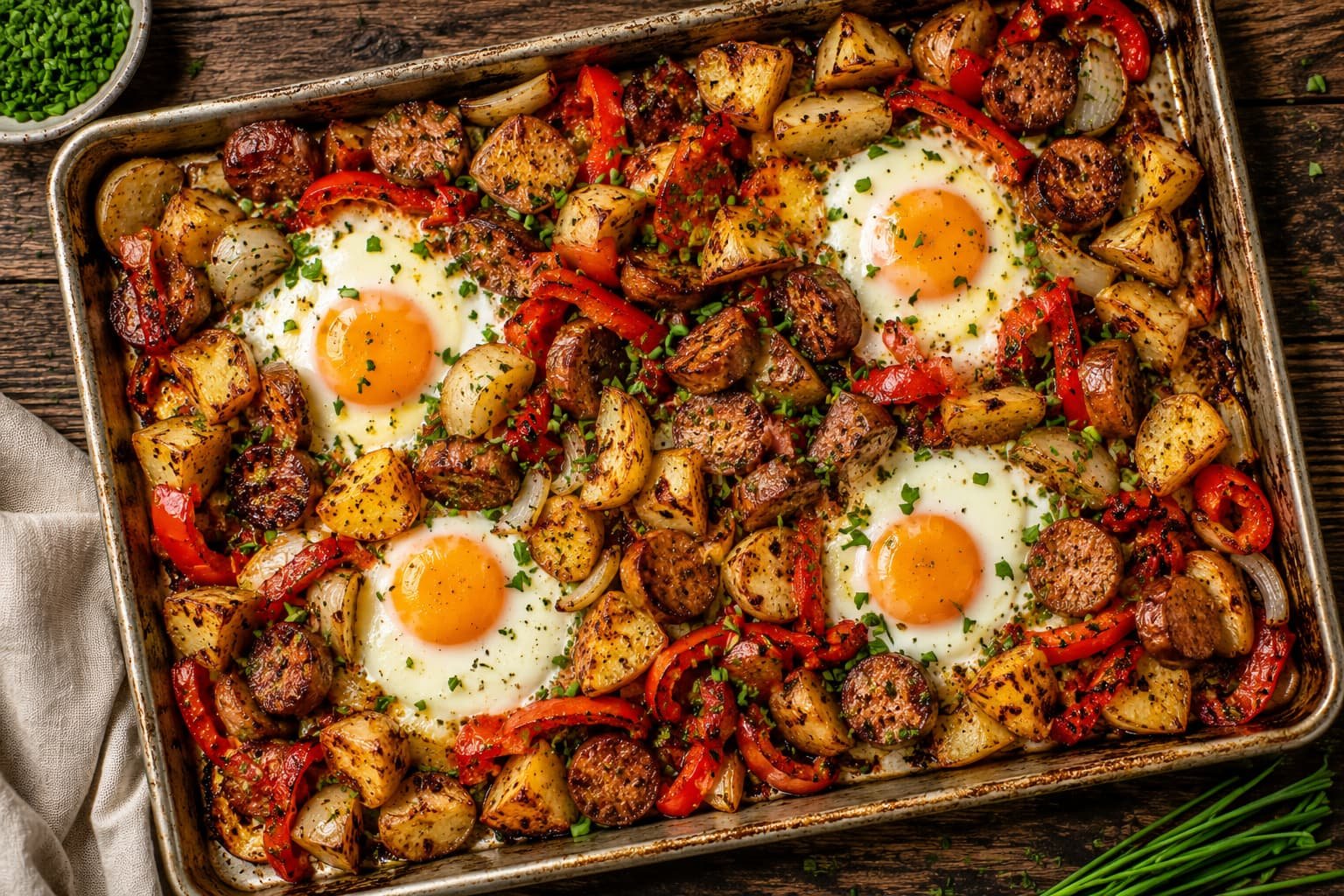
Twenty minutes later the kitchen smells like rendered sausage fat and smoked paprika, and the potatoes have gone the deep amber of a good roast chicken skin. Peppers soften at the edges. Then four eggs go into shallow wells you press into the hash with the back of a spoon, and eight minutes after that the whites are set, the yolks still liquid, and breakfast is on a single pan you can put straight on the table.
This is Easy Sheet Pan Breakfast Hash: potatoes, sausage, peppers, and onions roasted hard on one sheet pan, with eggs baked into it at the end. No skillet-flipping, no batches, no standing over anything.
| Prep Time | Cook Time | Total Time | Serves |
|---|---|---|---|
| 15 minutes | 40 minutes | 55 minutes | 4 people |
Why the Oven Beats the Skillet Here
A skillet hash asks you to stand there. You flip, you wait, you flip again, and because a 12-inch pan holds about half the potatoes you actually want, you do it twice — while the eggs need their own pan and by then the first batch has gone soft under a lid. The oven trades attention for surface area: a half sheet pan gives you 234 square inches of hot metal, enough for two pounds of potatoes in one layer with room between the cubes, and it leaves you free for the 25 minutes it takes.
What you give up is the deep, unified crust that a cast-iron skillet builds when you press the hash down and leave it. That crust is genuinely better. But it costs you forty minutes of standing and two batches, and on a Saturday morning with people in the house, the sheet pan version is the one that actually gets made.
What You’ll Need
2 pounds Yukon Gold potatoes, cut into ¾-inch cubes. Not ½-inch, not 1-inch. At ¾ inch the cubes finish cooking through at almost exactly the moment their outsides are properly browned. Smaller and the insides dry out; larger and you get crisp shells around chalky centers. Yukons have enough waxiness to hold their shape and enough starch to crisp. Russets crisp harder but crumble at the corners; red potatoes hold beautifully but never get quite as golden.
12 ounces breakfast sausage, casings removed if using links. Bulk sausage broken into rough ¾-inch pieces is what you want — the irregular edges catch more browning than neat rounds. Its fat renders out and coats the potatoes, which is why this recipe needs less oil than it looks like it should.
1 large red bell pepper, cut into ¾-inch pieces. Red, not green. Green peppers turn slightly bitter and grassy over 25 minutes of high heat; red ones sweeten.
1 medium yellow onion, cut into ¾-inch pieces. Keep it the same size as everything else — onion cut finer than the potatoes burns to black threads at the pan edges.
3 tablespoons olive oil, plus 1 tablespoon for preheating the pan.
1½ teaspoons smoked paprika. This is the ingredient that makes the dish taste like it took longer than it did. Sweet paprika is not a substitute — you lose the entire smoky backbone.
1 teaspoon garlic powder. Powder rather than fresh, and this is deliberate: fresh garlic burns to bitterness in a 425°F oven over 25 minutes. Powder distributes evenly and survives the heat.
1¼ teaspoons kosher salt and ¾ teaspoon black pepper.
4 large eggs.
3 tablespoons chopped fresh chives, for finishing. Chives over parsley here — the mild onion note lands better against the sausage fat.
For swaps: sweet potatoes work but cook faster, so cut them to 1-inch cubes and start checking at 18 minutes. Chorizo in place of breakfast sausage gives you a redder, spicier pan and renders more fat, so drop the oil to 2 tablespoons. For a meatless version, replace the sausage with 12 ounces of cremini mushrooms halved and 1 can of drained, rinsed chickpeas patted very dry — but add 2 extra tablespoons of oil, because there is no rendered fat to carry the seasoning.
Making It
- Put a half sheet pan (18 by 13 inches) in the oven and heat it to 425°F. Let the pan heat with the oven for at least 10 minutes after it reaches temperature. This is the step most recipes skip and the one that matters most.
- While the oven heats, cut the potatoes into ¾-inch cubes and rinse them in a colander under cold water for 30 seconds, until the water runs clear rather than cloudy. Then dry them thoroughly — spread on a kitchen towel, press a second towel on top, and be genuinely ruthless about it. Surface water turns to steam, and steam is the enemy of browning.
- Toss the dried potatoes with 3 tablespoons olive oil, the smoked paprika, garlic powder, salt, and pepper in a large bowl until every cube is coated and faintly orange. Add the sausage and toss once more, just enough to distribute.
- Pull the hot pan out and add the remaining tablespoon of oil — it will thin and shimmer across the surface within about three seconds. Tip the potato and sausage mixture onto the pan and spread it into a single layer with a spatula. Listen for that immediate crack of a sizzle. If the pan is silent, it was not hot enough, and the crust will not develop the same way.
- Roast 20 minutes without touching it. Resist opening the door. Every cube is building a browned face against the metal, and turning them early interrupts it before the crust sets.
- Add the peppers and onions, then toss everything once with a metal spatula. You will hear the browned bottoms release from the pan — scrape rather than lift. Peppers and onions go in now, not at the start; twenty-five minutes of high heat collapses them into something limp and sweet in the wrong way. Spread back into an even layer and return to the oven for 12 minutes.
- Take the pan out. The potatoes should be deep golden with darker edges, and a cube should give way completely when you press it with a spoon. If they are still firm at the center, give them 5 more minutes before moving on — the eggs are the last thing that happens, and there is no fixing undercooked potatoes afterward.
- Press four wells into the hash with the back of a large spoon, each about 3 inches across, spaced evenly and pushed down to the pan surface. Crack an egg into each one. The whites will spread a little into the hash; that is fine and it is how they anchor.
- Return to the oven for 8 minutes for runny yolks, 10 for jammy, 12 for fully set. At 8 minutes the whites are opaque and set at the edges with a faint tremble at the center, and the yolks move under the surface when you tilt the pan. That trembling is the signal — pull it there.
- Scatter the chives over everything and serve directly from the pan. A flaky salt finish over the eggs is worth the ten seconds it costs.
The Small Things That Decide It
Rinsing the potatoes feels like an unnecessary step. It is not. Cut potatoes release free surface starch, and that starch forms a thin gummy film in the oil that goes tacky rather than crisp. Thirty seconds of cold water removes it, and the drying afterward is what makes the rinse worth doing rather than counterproductive.
Space between the cubes is not a suggestion. Potatoes touching each other trap steam in the gap and both faces stay pale. If your two pounds of potatoes will not fit in a single layer with visible pan between the pieces, use two pans on two racks and swap their positions when you add the peppers.
Toss once, at minute 20, and only once. Every additional stir knocks off crust that has already formed and resets the browning clock on that face. This is the most common instinct to fight — the pan looks like it needs attention, and it does not.
Crack the eggs into a small bowl first and pour them into the wells — a yolk broken on the shell edge spreads through the hash and the runny center is gone. It costs four seconds. And salt the eggs after they come out, not before: salt on a raw white draws water to the surface and leaves a watery ring around each egg.
Where It Goes Wrong
The potatoes are soft and pale. Almost always a cold pan. A room-temperature sheet pan spends the first six minutes coming up to heat, and during those six minutes the potatoes are steaming in their own moisture. Preheat the pan. The 10 minutes cost you nothing since the oven needs that time anyway.
The eggs overcooked while you were doing something else. Eight minutes is eight minutes. At 425°F the window between a runny yolk and a chalky one is roughly three minutes wide. Set a timer, and put the pan on the counter the moment it goes off — the residual heat in the metal keeps cooking the eggs for another 90 seconds after they leave the oven.
The onions burned black at the pan edges. They were cut too small or added too early. Match them to the potato size and put them in at minute 20 as written.
The whole pan tastes bland despite the seasoning. The salt went on before the potatoes were dry, so it dissolved into the surface water and drained off with it. Dry first, then oil, then season.
Everything stuck to the pan and tore apart when you tossed it. Not enough oil on the preheated surface, or you tried to lift rather than scrape. Use a thin metal spatula and push under the crust at a low angle. Parchment prevents sticking entirely, but it also insulates the potatoes from direct metal contact and you lose some of the browning — I take the sticking.
Ways to Make It Your Own
The one with crispy kale. Add 4 cups of torn, stemmed kale tossed in a teaspoon of oil at minute 32, the same time as the eggs. In eight minutes it goes brittle and slightly charred at the edges and gives the pan a texture it otherwise lacks. This is the variation I make most.
Sweet potato and black bean. Swap in 2 pounds of sweet potatoes cut to 1-inch cubes, drop the sausage, and add a drained can of black beans at minute 20. The sweetness needs a counterweight, so add ½ teaspoon of chipotle powder to the spice mix and finish with lime juice rather than chives.
With cheese, done properly. Scatter 4 ounces of grated sharp cheddar over the hash right before you press the wells and add the eggs, so it melts under and around them rather than forming a crust on top. Cheese added at the very end sits on the surface and goes rubbery within two minutes on the table.
Herb and lemon, no smoke. Drop the smoked paprika, use 2 teaspoons dried oregano instead, and finish with the zest of a whole lemon and a squeeze of juice over the potatoes before the eggs go in. It reads Mediterranean rather than diner, and it is the version to make when you are serving it for dinner rather than breakfast.
Putting It on the Table
Serve it from the pan. Portioning it onto plates in the kitchen means the eggs cool and the yolks firm up on the walk to the table, and the pan itself keeps everything warm for a good fifteen minutes.
What it needs alongside is acid, not more richness. A bowl of quartered tomatoes with salt and olive oil, or sliced avocado with lime, does more for the plate than toast. Hot sauce on the table is not optional in my kitchen — the vinegar in it cuts the sausage fat directly.
If you want bread, make it sturdy enough to push hash onto — thick sourdough toast, or warm flour tortillas for people building their own. Soft sandwich bread disappears under it. For a crowd this doubles onto two pans cleanly, and you can leave the second pan eggless for anyone treating it as a side. It works as dinner with a sharp green salad, which is how it lands on my table more often than at breakfast.
Keeping and Reheating
Store the hash without the eggs if you know in advance you will have leftovers. Baked eggs do not survive refrigeration well — the whites go firm and slightly squeaky, and a reheated set yolk turns dry and grainy.
The hash itself keeps 4 days in an airtight container. What changes is the crust: refrigeration draws moisture from the interior of each cube out to the surface, so what was crisp on Saturday is soft by Sunday. The flavor holds fine; the texture is what you lose.
Reheat in a hot dry skillet over medium-high for 4 to 5 minutes without stirring for the first 3. Direct contact with metal drives that surface moisture off and re-crisps one face properly. A 400°F oven for 10 minutes works too and is easier for larger amounts. The microwave gets it hot in 90 seconds and leaves every cube soft — fine on a weekday, but it is not the same dish.
If you want the eggs again, fry fresh ones and set them on top of the reheated hash. It takes three minutes and it is the honest way to do it.
Approximate Nutrition Per Serving
| Calories | Protein | Carbs | Fat | Fiber |
|---|---|---|---|---|
| 584 kcal | 24 g | 44 g | 35 g | 5 g |
All values are approximate estimates provided for informational purposes only. Actual figures vary with sausage type, potato size, and portion.
One Pan, One Morning
What this dish gives you is the thing that most breakfast cooking takes away: you are not tethered to the stove while everyone else is awake and talking. The oven does the work in two stretches of twenty and twelve minutes, and you spend that time somewhere other than in front of a pan.
The trembling center of an egg at eight minutes is a small thing to learn to recognize. It is also the difference between this and every mediocre sheet pan breakfast you have eaten.