


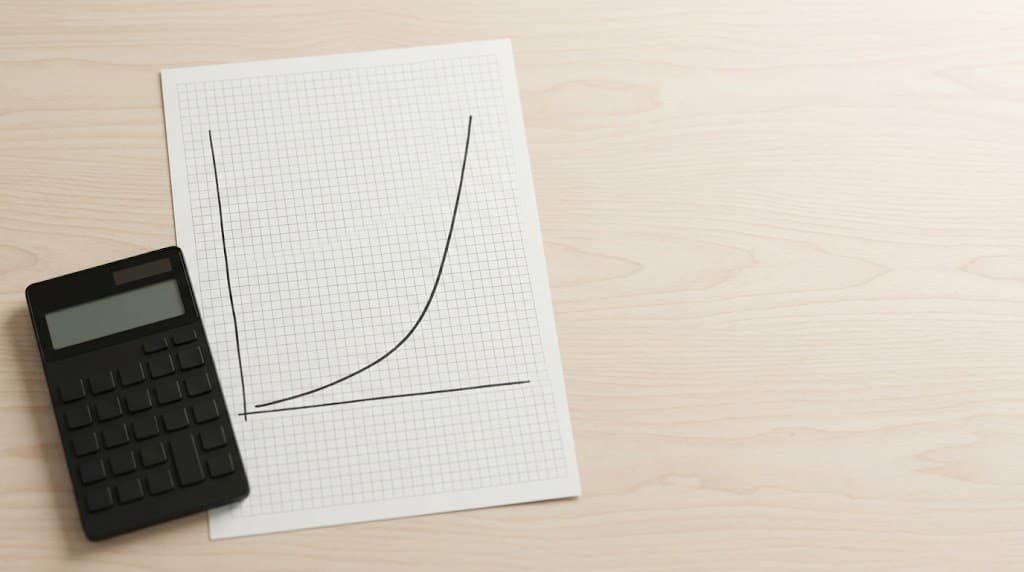
Compound interest is interest calculated on interest, not just on the original amount. A dollar earning interest once is simple math. A dollar earning interest, then earning interest on that interest, then earning interest on the new total the following year, is a different shape of growth entirely — slow at first, then visibly faster, and the difference between those two shapes is the entire subject of this article.
It works identically in reverse on debt, which is the part most explanations skip. The same mechanism that grows a balance in a savings account grows a balance owed on a credit card, and understanding one side means understanding both. Most explanations stop at the growth side because it is the more encouraging half of the story, but the debt side is where the same mechanism causes the most damage when it goes unnoticed.
The Number You Need Before Anything Else
The interest rate on whatever balance you are actually looking at — a savings account, a credit card, a loan — expressed as an annual percentage, and specifically whether it compounds monthly, daily, or annually. This detail is usually printed on a statement or account disclosure and is not the same as the headline rate advertised when the account was opened.
Find it by checking the most recent statement for that specific account rather than assuming it matches a number from memory or an advertisement. Every calculation in this article depends on both the rate and the compounding frequency, and the frequency changes the outcome more than most people expect — two accounts advertising the identical annual rate can produce meaningfully different results depending on whether that rate compounds monthly or annually.
What Ignoring This Actually Costs
On debt, the cost is concrete and checkable today: a $5,000 credit card balance at 22 percent annual interest, compounded monthly, paying only the minimum payment of roughly $125 a month, takes over six years to clear and costs more than $3,800 in interest alone — nearly as much as the original balance, paid for the privilege of paying slowly. This figure comes directly from the compounding formula applied to real, current terms, not a projection.
On savings, the cost of ignoring compounding is different in kind: it is not a loss but a foregone gain, and it is largest specifically in the years people are most tempted to skip, because early compounding produces the smallest-looking numbers even though it is doing the most structural work. A dollar not saved at twenty-five is not simply a dollar missing at retirement — it is that dollar plus every year of compounding it would have generated, which is why the timing of starting matters as much as the amount.
What You’ll Need to Get Started
A calculator with an exponent function, or any basic online compound interest calculator — no specialized software required. The interest rate and compounding frequency from Section 2. Whichever number you are actually trying to understand: a savings balance you are building, or a debt balance you are paying down.
You do not need investment software, a brokerage account, or any product to understand the mechanism itself. The formula works the same way regardless of what account or balance it is applied to, and understanding it does not require opening anything new — this article is about the calculation, not about any specific product it might eventually be applied to.
How to Verify It Yourself, Step by Step
- Write down the principal — the starting balance — and the annual interest rate as a decimal. A 5 percent rate is 0.05 in the calculation.
- Identify the compounding frequency: annually, monthly, or daily. This determines how many times per year interest gets added to the balance, which changes the outcome even at an identical annual rate.
- Divide the annual rate by the number of compounding periods per year. A 6 percent annual rate compounded monthly uses 0.5 percent — 0.06 divided by 12 — as the rate applied each individual month.
- Apply that period rate to the balance, then add the result to the balance before the next period. This is the entire mechanism: each period’s interest calculation uses the previous period’s ending balance, not the original starting amount.
- Repeat for the number of periods you are calculating — 12 for one year monthly, 60 for five years monthly. Doing this by hand for more than a few periods is impractical, which is exactly why the shortcut formula in the next step exists.
- Use the compound interest formula directly instead of repeating step four manually: final balance equals principal multiplied by (1 plus the period rate) raised to the power of the number of periods. A calculator with an exponent key computes this in seconds once the numbers from steps one through three are in hand. Running the same formula with a slightly different rate or a different number of periods is the fastest way to see how sensitive the final figure is to each input.
A Worked Example With Real Figures
Take a $10,000 starting balance and an assumed 6 percent annual rate compounded monthly as an illustrative example — a rate chosen for clean arithmetic, not a prediction of what any specific account will actually pay. Substitute the real rate from your own statement to run the same calculation against your own numbers.
| Year | Balance | Interest Earned That Year |
|---|---|---|
| Start | $10,000 | — |
| Year 1 | $10,617 | $617 |
| Year 10 | $18,194 | $1,058 |
| Year 20 | $33,102 | $1,923 |
Notice what happens between year one and year twenty: the balance does not grow by the same dollar amount each year, even though the rate never changes. The interest earned in year twenty is more than three times the interest earned in year one, because year twenty’s calculation is applied to a much larger balance — the compounding, not a changing rate, is what produces the acceleration. This is the entire mechanism stated in one comparison, and every other section of this article is really just this same pattern applied to a different starting point or a different direction.
Where the Common Advice Goes Wrong
The most repeated claim about compound interest — that it makes any amount, however small, grow into something significant given enough time — is true in the narrow mathematical sense and misleading in practice, because it omits inflation. A dollar compounding at 6 percent while prices rise at 3 percent is really only gaining ground at roughly 3 percent in terms of actual purchasing power, not the full 6 percent the raw balance suggests. The formula in this article calculates the balance correctly; what that balance can actually buy in twenty years is a separate question the formula alone does not answer.
A second common oversimplification treats “compound interest” as if it only applies to investment accounts, when the identical mechanism drives credit card and loan balances upward with the same force it drives savings upward. Someone carrying a balance and someone building one are experiencing the same mathematics pointed in opposite directions, and the person paying only a minimum payment on a credit card is on the losing side of exactly the mechanism the person saving is trying to benefit from.
What Changes as Your Income or Situation Changes
Working with debt rather than savings, the same formula applies with the balance decreasing rather than growing, but the practical lesson flips: since the mechanism accelerates over time, the highest-interest balance costs disproportionately more the longer it sits, which is the mathematical reason paying down the highest rate first, ahead of lower-rate balances, reduces total interest paid more effectively than spreading payments evenly. This holds even when the highest-rate balance is not the largest one in dollar terms — the rate, not the size, is what the compounding formula responds to most strongly over time.
Starting to save at fifty rather than twenty-five does not change how the formula works, only how many compounding periods are available before a given goal. The same monthly amount produces a meaningfully smaller final balance with fewer years of compounding behind it — not because the math changes, but because there are simply fewer periods for the acceleration described in Section 6 to take effect.
With irregular income where the amount saved each month varies, the compounding still applies to whatever balance actually exists at each period, regardless of how uneven the contributions were to build it — the formula does not care about the pattern of deposits, only the balance at each compounding point.
When to Stop and Get Professional Help
This article explains the mechanism of compound interest and is not a substitute for professional guidance on specific decisions: choosing between investment products, structuring retirement accounts, or planning around a specific financial goal with a fixed deadline. A licensed financial advisor should be involved for decisions like those, not because the mathematics here is incomplete, but because applying it to a specific product or strategy involves considerations — fees, risk, tax treatment — that this explanation of the underlying mechanism does not cover.
What to Check and How Often
Annually: the actual interest rate and compounding frequency on any account this applies to, since rates on savings accounts and credit cards change over time and a calculation run last year is not automatically still accurate.
Whenever a balance changes significantly: rerun the calculation from Section 5 with the new principal rather than assuming the old projection still holds — a large deposit or a large payment changes the base the formula compounds from, which changes every subsequent figure.
Whenever comparing two accounts or two debts: check both the rate and the compounding frequency for each, not just the rate. A slightly lower rate compounded daily can produce a similar or higher effective cost than a slightly higher rate compounded annually, and the frequency is easy to overlook when only the headline rate gets compared.
Closing Note
The mechanism itself is simple enough to calculate by hand for a few periods, which is worth doing at least once, because seeing the acceleration in your own numbers makes it concrete in a way a general description does not. The same formula explains why a debt left alone grows faster than it looks like it should, and why savings started early outperform larger amounts started late.
Pull the actual rate and compounding frequency from one real account today, and run the formula from Section 5 against your own balance. That single calculation, using your own numbers instead of an example, is what makes the mechanism actually click.