

Most furniture arranging advice assumes a room that is roughly rectangular, with one clear focal wall and enough space to center everything around it. An awkward room — an angled wall, an offset alcove, three doorways instead of one — breaks that assumption immediately, and furniture placed according to standard advice in a room like this usually ends up blocking the exact path someone needs to walk to get from one door to another.
This is a system built around fixing that specific problem first — mapping how people actually move through the room before placing a single piece of furniture, rather than arranging furniture first and discovering the walking paths do not work afterward. The order matters more than any single furniture choice that follows it.
Why Traffic Flow Has to Come First
A room’s doorways and the paths between them are fixed. Furniture is not. Arranging furniture before understanding how people actually need to move through the space means the furniture placement is guessing at something directly measurable, and in an awkward room specifically, that guess is far more likely to be wrong, because irregular walls already create pinch points and dead corners that a standard rectangular room does not have to contend with.
Mapping traffic flow first turns furniture arrangement from a single complex problem — fit everything in while keeping the room walkable — into two simpler, sequential ones: first protect the paths people actually need, then arrange furniture in whatever space is left over. The second problem is genuinely easier to solve once the first one is settled, because it no longer has to account for movement and seating at the same time.
What You’ll Need
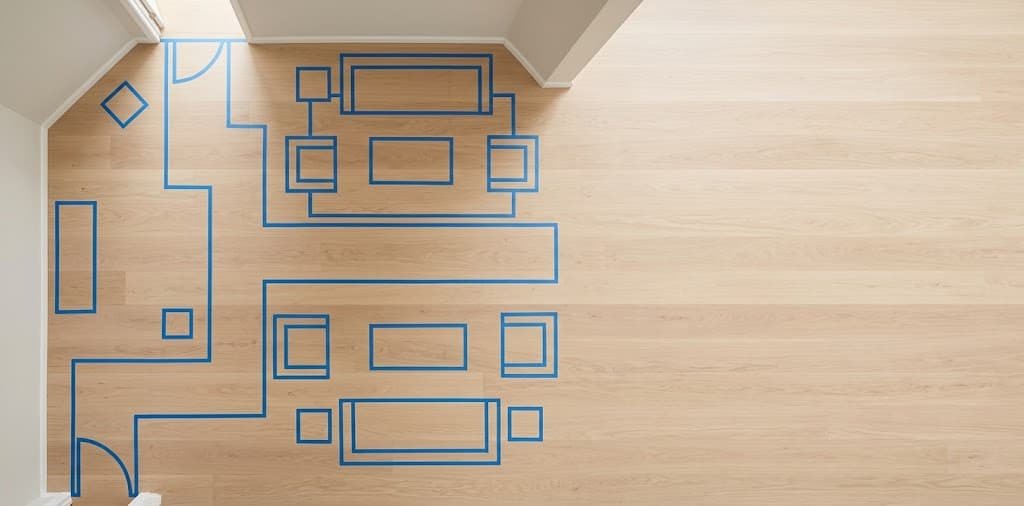
- Painter’s tape, for marking both walking paths and furniture footprints directly on the floor before moving anything heavy.
- A tape measure and the room’s actual dimensions, including the position of every doorway, window, and any fixed architectural feature like a radiator or a built-in.
- A willingness to actually walk the marked paths repeatedly during planning, since a path that looks adequate on paper sometimes feels tight the moment you walk it carrying something, which is the real test that matters.
How to Arrange an Awkward Room, Step by Step
- Mark every doorway and identify which ones genuinely get used regularly, since a room with three doorways sometimes has one that is rarely used, and treating a rarely used doorway with the same priority as a main path wastes valuable furniture space protecting a route nobody actually takes.
- Tape out the direct path between each pair of regularly used doorways, at a minimum width of 30 to 36 inches, before considering any furniture placement at all. These taped lines are now fixed constraints, not suggestions.
- Identify what remains once the paths are marked — this is your actual usable furniture zone, which in an awkward room is often a more regular, simpler shape than the room’s overall outline suggests, even though it rarely matches the room’s largest wall.
- Choose a furniture arrangement that fits entirely within that usable zone, rather than trying to fit furniture to the room’s overall irregular footprint. An awkward room’s usable zone, once isolated this way, is often arrangeable using fairly standard furniture groupings.
- Use an angled wall or an alcove as a deliberate anchor for one piece rather than fighting it, since forcing furniture to sit flush against an irregular wall usually wastes more space than angling one piece to match it directly.
- Walk every marked path again with the furniture arrangement taped out, confirming the paths still function once the furniture footprint is added. This is the step that catches conflicts between the two systems before anything heavy actually gets moved.
The Detail That Actually Decides This
Treating the traffic paths as genuinely fixed, decided before any furniture consideration, is what separates a workable awkward-room arrangement from one that looks fine on paper and fails the moment someone tries to walk through it.
The common mistake is treating furniture placement and traffic flow as one combined decision, adjusting both simultaneously until something roughly works — which in a rectangular room is forgiving enough to succeed through trial and error, but in an awkward room usually produces a compromise where neither the furniture grouping nor the walking path is quite right. Separating the two into a strict sequence — paths first, furniture within whatever remains — removes that compromise, because the path decision never gets quietly eroded to accommodate a piece of furniture that “almost” fits.
This is also why the awkward shape itself often stops being the actual obstacle once this order is followed. The usable zone left over after paths are marked is frequently more regular than the room’s full outline suggested, and arranging furniture within a smaller, regular zone is a fundamentally easier problem than arranging it within an irregular one.
Practical Notes
An angled wall corner is often better used for a single asymmetric piece — a corner desk, an angled bookshelf — than for a symmetric furniture grouping that has no natural way to sit evenly against it.
A round or oval rug placed within the usable furniture zone, rather than one shaped to match the room’s overall irregular footprint, helps visually define the seating area as its own regular shape distinct from the room’s odd outline.
In a room with an awkward offset alcove, treating that alcove as a distinct smaller zone — a reading nook, a plant display — rather than trying to integrate it into the main furniture grouping, often works better than forcing one unified arrangement across the whole irregular footprint.
Common Mistakes to Avoid
Arranging furniture first and adjusting traffic paths around it afterward is the most common mistake, and it is precisely backward from the approach this guide recommends — paths are fixed by the room’s doorways, and furniture is the flexible variable, not the other way around.
Trying to force a symmetric, centered furniture arrangement into a room with no genuinely central wall is the second common mistake — awkward rooms rarely have the kind of single dominant focal wall that symmetric arrangements depend on, and forcing symmetry where the room’s shape does not support it usually wastes the exact corners and angles that would otherwise become useful asymmetric zones.
Ignoring a rarely used doorway entirely rather than deciding deliberately whether to protect or block it is the third — an unused doorway still needs an intentional decision, since leaving it ambiguous means furniture can end up half-blocking a path that is used occasionally, which is worse than either fully protecting it or deliberately repurposing it.
Where to Invest
At the budget tier, the entire traffic-mapping method described above costs nothing beyond a roll of tape and time, and it captures most of the actual benefit — knowing what genuinely fits before buying anything prevents the most expensive mistake in this category, which is furniture that does not work in the space it was bought for.
At the mid-range tier, furniture chosen specifically for its footprint shape — a rounded ottoman instead of a square one, an angled desk instead of a straight one — starts to matter, since pieces designed with irregular spaces in mind fit an awkward usable zone more efficiently than standard rectangular furniture forced into the same space.
At the higher-investment tier, custom or made-to-measure pieces sized precisely to an unusual alcove or angled zone solve fit problems that no off-the-shelf furniture, however carefully chosen, fully resolves — worth it specifically for a genuinely unusual space where standard furniture consistently leaves either wasted room or blocked paths.
Adjusting for Your Specific Room
In a room with more doorways than usable wall space, prioritize protecting paths over maximizing furniture footprint, and accept a smaller furniture grouping than the room’s total square footage suggests is possible — a room with many entrances functions more like a hallway with seating than a true dedicated room, and arranging it accordingly avoids constant friction.
In a long, narrow awkward room rather than one with angled walls, break the space into two or more distinct functional zones along its length instead of one unified furniture grouping, since a single arrangement stretched across an overly long space usually leaves an awkward dead zone in the middle regardless of how the furniture is chosen.
In a room where the irregular shape comes from a structural element like a support column or a fireplace jutting into the space, treat that fixed element the same way as a doorway during the mapping phase — a permanent obstacle to plan paths and furniture around, not something to be solved or hidden.
Keeping It Working
Revisit the traffic paths whenever adding a new piece of furniture, even a small one, rather than assuming the established paths will automatically remain clear — a single new side table added without rechecking clearance is a common way an otherwise well-planned awkward room slowly loses its functionality over time.
Reassess the whole arrangement if the room’s actual use changes significantly, since a path and furniture layout planned around one use case does not automatically hold up if the room starts serving a different daily function.
Where to Start
The honest case here is specific: mapping and protecting traffic paths before arranging any furniture turns an awkward room from one complex problem into two simple sequential ones, and that order matters more than any individual furniture choice that follows it.
Tape out your room’s actual doorway-to-doorway paths today, before considering any furniture at all. That single map is what makes every decision after it easier, in a room that would otherwise fight you at every step of the process.