


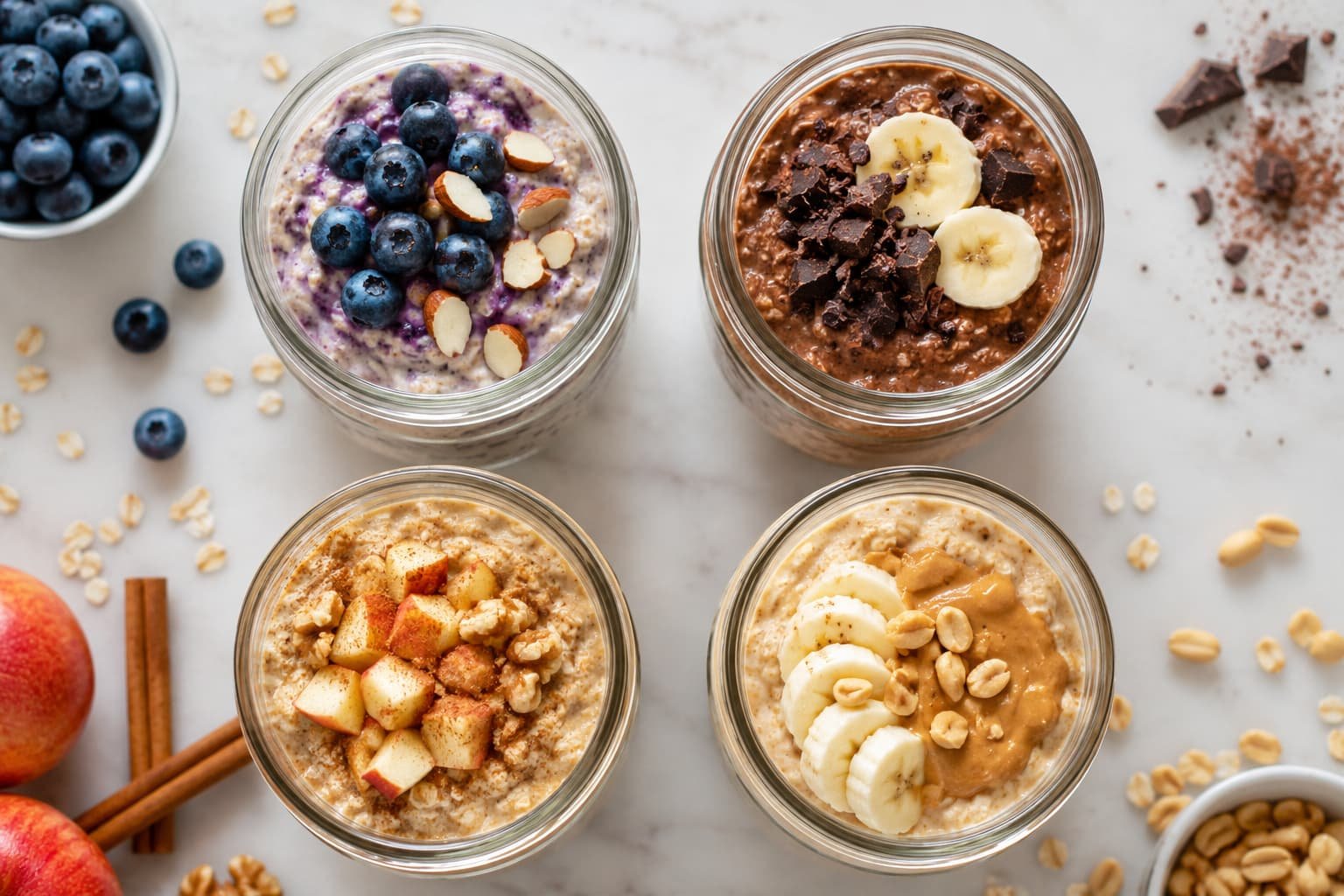
Ten minutes on Sunday night gets you four breakfasts that are already done. Not “mostly done” — done. You take a jar out of the fridge, add whatever crunchy thing you like on top, and eat it standing up if that is the kind of morning it is.
The reason most homemade overnight oats taste flat is not the oats or the ratio. It is that people skip the salt and the yogurt. An eighth of a teaspoon of salt per jar and a couple of spoonfuls of Greek yogurt turn a bland, wet bowl of grain into something with tang and body. Those two additions are the whole difference, and I will keep coming back to them.
| Prep Time | Rest Time | Makes | Keeps |
|---|---|---|---|
| 10 minutes | 8 hours | 4 jars | 4 days |
Why These Are Worth Ten Minutes of Your Sunday
They actually get eaten. That sounds like a low bar, but most make-ahead breakfasts fail because they need something from you in the morning — heating, assembling, a decision. These need nothing. Cold from the jar is how they are meant to be eaten.
Four different flavors in one batch is the part that keeps this going past the first week. I have made four identical jars before, and by Wednesday I was eating them out of obligation. Four different jars is the same ten minutes of work and it changes how the week feels.
The ingredients are also ones you already have, or ones that keep. Rolled oats, milk, yogurt, a jar of peanut butter, frozen blueberries, an apple, cocoa powder. Nothing here goes bad on you if plans change.
One honest caveat before we go further: the texture is soft and creamy, closer to a thick porridge than to anything with chew. If you want oats with real bite, this is not the technique — you want steel-cut oats cooked on the stove. I would rather tell you that now than have you make four jars and find out you do not like it.
What You’ll Need
The base, per jar (multiply by four):
- ½ cup old-fashioned rolled oats — Rolled oats, not quick oats and not steel-cut. Quick oats are pre-cut and partially cooked, so they absorb liquid within about 90 minutes and collapse into paste by morning. Steel-cut oats never soften properly cold — after 12 hours they are still gritty and unpleasant. This is not a preference, it is how the three cuts behave.
- ⅔ cup milk — Whole dairy milk gives the creamiest result. Unsweetened almond milk works and produces a noticeably thinner, looser jar, so cut it to ½ cup plus 2 tablespoons. Oat milk is the best non-dairy option here; its own starch adds body.
- ¼ cup whole-milk Greek yogurt — Do not skip this. It adds tang that stops the jar tasting like sweet wet cereal, and it thickens the texture into something you can eat with a spoon rather than drink. Nonfat Greek yogurt separates into a watery layer by day three; whole-milk does not.
- 1 teaspoon chia seeds — One teaspoon, not a tablespoon. Chia absorbs roughly ten times its weight in water, and a tablespoon per jar turns the whole thing into a slick, gelatinous pudding. One teaspoon just tightens it.
- 2 teaspoons maple syrup — Adjust after the first batch. Maple over honey, because honey thickens and turns slightly grainy at refrigerator temperature while maple syrup stays fluid and mixes in evenly.
- ⅛ teaspoon kosher salt — The most commonly skipped ingredient in overnight oats and the reason so many versions taste like nothing. Salt does not make them salty at this quantity; it makes the oats taste like oats and the fruit taste like fruit.
- ¼ teaspoon vanilla extract — Worth including in every jar, including the chocolate one.
Containers: four wide-mouth 12-ounce mason jars. Twelve ounces is the right size — an 8-ounce jar fills to the brim and you cannot stir it, and a 16-ounce jar leaves so much headspace that the oats spread thin and the top layer dries slightly. Wide-mouth matters because a spoon has to reach the bottom.
How to Make Them
- Line up your four jars and add the dry ingredients to each first — oats, chia seeds, and salt. Doing dry before wet means you can tip the jar and see whether the salt actually went in. I have made an unsalted jar by accident more than once and it is genuinely noticeable.
- Add the milk, yogurt, maple syrup, and vanilla to each jar. Pour the milk in before the yogurt — the yogurt slides off the spoon into liquid much more easily than it comes off into dry oats.
- Stir each jar hard for a full 20 seconds, scraping the bottom. This is longer than it feels like it needs. Chia seeds sink and clump at the bottom corner if you stir gently, and you will find a gritty seed cluster down there in the morning. The mixture should look uniform and loose — noticeably wetter than you expect the finished oats to be.
- Add the flavor ingredients for each jar (see the four variations below), then stir each one again briefly.
- Lid them and refrigerate at least 4 hours, ideally 8 to 12. At the 4-hour mark the oats are edible but the centers still have a faint chalkiness. By 8 hours they are fully hydrated and creamy. Twelve hours is my preference and it is why Sunday night for Monday morning works perfectly.
- In the morning, stir once and check the consistency. If it is thicker than you want — and it will be by day three — add a splash of milk, a tablespoon at a time. Then add your toppings and eat.
The Four Variations
Peanut Butter Banana
Add 1 tablespoon natural peanut butter and an extra tablespoon of milk to the base. Warm the peanut butter for 15 seconds in the microwave first — cold peanut butter refuses to disperse and you get a solid lump at the bottom of the jar.
Add the banana in the morning, not the night before. Sliced banana sitting in a jar overnight goes brown and slimy, and worse, its flavor takes over every other jar-mate in the mixture. Half a banana sliced in at breakfast takes ten seconds and tastes completely different.
Blueberry Lemon
Add ⅓ cup frozen blueberries and the zest of half a lemon to the base.
Frozen berries here, not fresh — and this is the one case where frozen is genuinely the better choice. Frozen blueberries release their juice as they thaw overnight, which sweetens and colors the oats through. Fresh blueberries stay intact, contribute nothing to the base, and turn mushy by day two. Zest rather than juice, because lemon juice added the night before curdles the yogurt slightly and you get a grainy texture.
Apple Cinnamon
Add ½ a small apple, grated on the large holes of a box grater, plus ½ teaspoon ground cinnamon and a squeeze of lemon juice over the grated apple before it goes in.
Grated, not diced. Diced apple stays crisp and separate — you get cold oats with hard apple chunks in them. Grated apple softens into the oats and its moisture becomes part of the base. The lemon squeeze is there to stop it browning, and it takes two seconds.
Chocolate Almond
Add 1½ tablespoons unsweetened cocoa powder, an extra teaspoon of maple syrup, and 2 tablespoons of hot water.
Whisk the cocoa powder with the hot water into a smooth paste before adding anything else to the jar. Cocoa is hydrophobic — dumped dry into cold milk it forms stubborn dry pockets that never break up no matter how long you stir. Thirty seconds with hot water solves it completely, and it also blooms the cocoa so the chocolate flavor is deeper. Top with sliced almonds in the morning.
Tips That Actually Make a Difference
Keep all crunchy toppings out of the jar until you eat. Nuts, granola, seeds, coconut flakes — anything crunchy goes soft within about six hours in that environment. Put them in a small container and add them at the table. This is the single most common thing people get wrong.
Make five jars, not four. The fifth one is the one you eat on the day you were not planning to be home for breakfast. It costs you thirty extra seconds and it is the difference between this working and not.
Taste one jar after the first night and adjust the sweetness for the rest of the batch. Maple syrup quantity is personal and 2 teaspoons is my baseline, not a rule. Adjusting after you have tasted is more useful than guessing.
Toast the oats first if you want a real upgrade. Spread the dry oats on a sheet pan and toast at 350°F for 8 minutes, until they smell nutty and go a shade darker. Let them cool fully before using. It adds ten minutes to the process and it makes the base taste substantially less flat — this is the thing I do when I have the time.
Label the lids with a piece of tape. Chocolate and blueberry are obvious. Apple cinnamon and peanut butter look identical through glass at 6:45 in the morning.
Mistakes to Watch Out For
Using quick oats. They turn to glue. Not soft, not creamy — glue. If quick oats are all you have, cut the milk to ½ cup and eat it within 12 hours, but know that the texture will still be worse.
Skipping the salt. I am repeating this because it is the most consequential omission. Unsalted overnight oats taste washed out and vaguely sweet, and people conclude they do not like overnight oats. They do not like unsalted food.
Adding fresh berries the night before. They leach water into the base, thinning it, and their skins go slack. Frozen berries are designed for this; fresh berries belong on top in the morning.
Filling the jar to the top. The oats expand roughly 20 percent as they absorb the milk. Fill to about an inch below the rim or you will find the overflow on the refrigerator shelf.
Stirring in dry cocoa powder. Covered above, but worth restating as a mistake: it does not dissolve. Bloom it in hot water first, every time.
Expecting the same texture on day four as day one. They soften progressively. Day one and two are the best texture, day three is still good, day four is soft but fine. Day five is worth skipping.
What to Eat Alongside
A jar of overnight oats runs about 400 calories and lands somewhere between a snack and a full breakfast, depending on your morning. What it lacks is protein and anything hot.
A hard-boiled egg is the most useful addition, and it fits the make-ahead logic — boil four on Sunday alongside everything else. Coffee is the obvious companion, and there is a real reason beyond habit: the oats are cold and soft, and something hot and bitter alongside them keeps the whole breakfast from being one uniform sweet, cold texture.
If you are feeding kids, a small bowl of fresh fruit on the side works better than mixing more fruit into the jar. They eat it, and the jar stays the texture you made it.
For a bigger breakfast — a weekend, or after a workout — a slice of toast with the same peanut butter you used in the jar is the honest, easy answer.
How Long They Actually Keep
Four days in the refrigerator, and eat them in the order the flavors hold. The blueberry lemon and chocolate almond jars are just as good on day four as day one. The apple cinnamon is best in the first two days — grated apple loses its brightness and starts tasting slightly cooked. The peanut butter jar holds fine, since you are adding the banana fresh each morning anyway.
They thicken every day. By day three each jar needs 2 to 3 tablespoons of milk stirred in to come back to the texture it had on Monday. This is not a sign anything went wrong — the oats are simply still absorbing.
Do not freeze them. The oats survive freezing but the yogurt separates permanently and you get a watery layer sitting on top of grainy oats. There is no way to stir that back together.
One thing to know: if a jar smells sharp or sour rather than tangy, or the surface looks glossy and slick, throw it out. Dairy plus grain at refrigerator temperature is generally reliable for four days, but four days is the limit and not a target.
Approximate Nutrition Per Jar
| Calories | Protein | Carbs | Fat | Fiber |
|---|---|---|---|---|
| 412 kcal | 16 g | 54 g | 14 g | 8 g |
These numbers are estimates provided for informational purposes only, averaged across the four variations. Actual values shift with the milk you use, the amount of maple syrup, and your toppings.
Final Thoughts
What makes these worth doing is not that they are healthy or fast, though both are true. It is that at 6:45 on a Tuesday there is no decision to make and nothing to cook, and the jar tastes like someone made it on purpose rather than out of resignation. The salt and the yogurt are what get you there.
Make the four this Sunday, taste them Monday, and adjust the maple syrup for next week. That is really all there is to it.