

The failure of most Sunday meal prep is not the cooking. It is opening the refrigerator on Wednesday to find five identical containers of the same chicken and rice you have already eaten twice, and deciding to buy lunch instead. The food was fine. The system was wrong.
An hour is enough time to produce five distinct lunches, and the way to do it is to stop cooking meals and start cooking components: one tray of roasted vegetables, one pot of grain, one sheet pan of protein, and two sauces. Assembled in different combinations across the week, those five components read as five different lunches — a grain bowl on Monday, a wrap on Tuesday, a salad with warm grains on Wednesday. Same forty minutes of oven time, entirely different plates.
What follows is the timeline I use, built around running the oven and the stovetop in parallel and finishing with everything cooled properly before it goes into containers. That last part matters more than any recipe here.
| Active Time | Total Time | Yields | Keeps |
|---|---|---|---|
| 35 minutes | 60 minutes | 5 lunches | 4 days |
Why Component Prep Beats Batch Meals
Palate fatigue is a real constraint and most meal prep guides ignore it. Eating the identical dish five days running is not a discipline problem; it is a design problem. Components solve it because the variable is the combination, not the cooking.
There is a textural argument too. A fully assembled bowl sealed on Sunday has four days for moisture to migrate — dressing wicks into the grains, the grains soften the roasted vegetables, and everything converges on one uniform texture by Thursday. Stored separately, the vegetables keep their browned edges.
The third reason is arithmetic. Five separate recipes means five sets of prep and roughly two and a half hours. Four components cooked simultaneously across one oven and one burner means three pans and sixty minutes. The savings come almost entirely from cooking in parallel rather than in sequence — which is the actual skill here.
What to Buy
The protein — 2½ pounds boneless, skinless chicken thighs. Thighs, not breasts, and this is the single most consequential choice in the plan. Breast meat holds roughly 5 percent less intramuscular fat, and after four days of refrigeration and a reheat cycle it turns dry and stringy in a way thighs do not. If you want a meatless version, use two 15-ounce cans of chickpeas, drained, rinsed, and dried thoroughly on a towel before roasting — wet chickpeas steam instead of crisping.
The grain — 1½ cups dry pearled farro. Farro over rice for meal prep, without hesitation. Its bran layer keeps the grain firm through four days of refrigeration, while white rice retrogrades — its starch molecules recrystallize in the cold and the texture goes chalky and firm by day three. Quinoa is the next best choice; brown rice holds better than white but takes 45 minutes and breaks the timeline.
The roasting vegetables — 1½ pounds broccoli florets and 1 pound sweet potatoes cut into ¾-inch cubes. Both hold their structure through reheating. Zucchini and summer squash do not; they release water in storage and go limp by Tuesday.
The raw element — 5 ounces baby spinach or arugula, and 1 pint cherry tomatoes. These are never cooked and never dressed in advance. They go into each container the morning you eat it.
For the lemon tahini sauce: ⅓ cup tahini, 3 tablespoons lemon juice, 1 small garlic clove grated, ½ teaspoon salt, and 4 to 6 tablespoons cold water.
For the herb yogurt sauce: ¾ cup whole-milk Greek yogurt, ¼ cup chopped dill, 2 tablespoons chopped chives, 1 tablespoon lemon juice, ½ teaspoon salt. Use whole-milk yogurt — nonfat separates into a watery layer within two days.
Pantry: 5 tablespoons olive oil, 2 teaspoons smoked paprika, 2 teaspoons ground cumin, 1 teaspoon garlic powder, 2½ teaspoons kosher salt, 1 teaspoon black pepper.
Containers: five wide, shallow containers rather than five tall ones. Depth is the variable that governs how fast food cools, and cooling speed is what determines whether Thursday’s lunch is still good.
The One-Hour Timeline
- Minute 0: Heat the oven to 425°F with two racks in place, upper-middle and lower-middle. Put a kettle or covered pot of water on to boil for the farro. Starting the water now is what keeps the grain off the critical path later.
- Minutes 1 to 8: Cut the vegetables. Sweet potatoes into ¾-inch cubes, broccoli into florets roughly the size of a walnut. Uniform size is not cosmetic — a florets-and-stalks mix cooks unevenly and you get scorched thin edges alongside raw stems.
- Minutes 8 to 11: Toss and pan the vegetables. Sweet potatoes with 2 tablespoons oil, 1 teaspoon smoked paprika, and ½ teaspoon salt on one sheet pan. Broccoli with 1½ tablespoons oil, the garlic powder, and ½ teaspoon salt on another. Keep them on separate pans — sweet potatoes need 30 minutes, broccoli needs 20, and combining them guarantees one is wrong.
- Minute 11: Sweet potatoes into the oven on the lower rack.
- Minutes 11 to 16: Season the chicken and start the farro. Pat the thighs dry, then coat with 1½ tablespoons oil, the cumin, remaining 1 teaspoon smoked paprika, 1½ teaspoons salt, and the pepper. Add the farro to the boiling water — 1½ cups grain to 4½ cups water — with 1 teaspoon salt, and set it to a steady simmer, uncovered.
- Minute 16: Chicken onto a third sheet pan, into the oven on the upper rack. Space the thighs at least an inch apart. Crowded thighs release moisture that pools and steams the undersides pale.
- Minutes 16 to 25: Make both sauces. Whisk the tahini with lemon juice and grated garlic first — it will seize into a thick paste, which is normal and expected. Add cold water a tablespoon at a time, whisking, until it loosens into a pourable cream. Cold water emulsifies tahini more reliably than warm. Then stir together the yogurt sauce. Both go into small jars.
- Minute 31: Broccoli into the oven on the lower rack, beside or below the sweet potatoes. Both come out at minute 51.
- Minute 35: Check the farro. It is done when the grains are tender with a distinct chew at the center — bite one. Drain it, then spread it in a thin layer across a rimmed baking sheet rather than leaving it in the pot. A pot of hot farro takes over an hour to cool; spread on a sheet it drops below 70°F in about 15 minutes. Dress it now, while warm, with 1 tablespoon olive oil and a pinch of salt — warm grains absorb dressing, cold grains only get coated.
- Minute 40: Pull the chicken when an instant-read thermometer reads 175°F at the thickest part. Thighs at 175°F rather than 165°F have had time to break down connective tissue, which is what keeps them tender through reheating on day four. Let them rest 10 minutes, then slice against the grain into ½-inch strips.
- Minute 51: Vegetables out. Sweet potatoes should be browned at the edges and yield to a fork; broccoli should have charred tips and still snap slightly at the stem. Pull both about 15 percent short of how you would want to eat them tonight — reheating will finish the job, and vegetables roasted to full tenderness now turn to mush by Wednesday.
- Minutes 51 to 58: Cool everything, uncovered, in a single layer. Spread the vegetables and chicken across their pans rather than piling them. Do not skip this and do not shorten it.
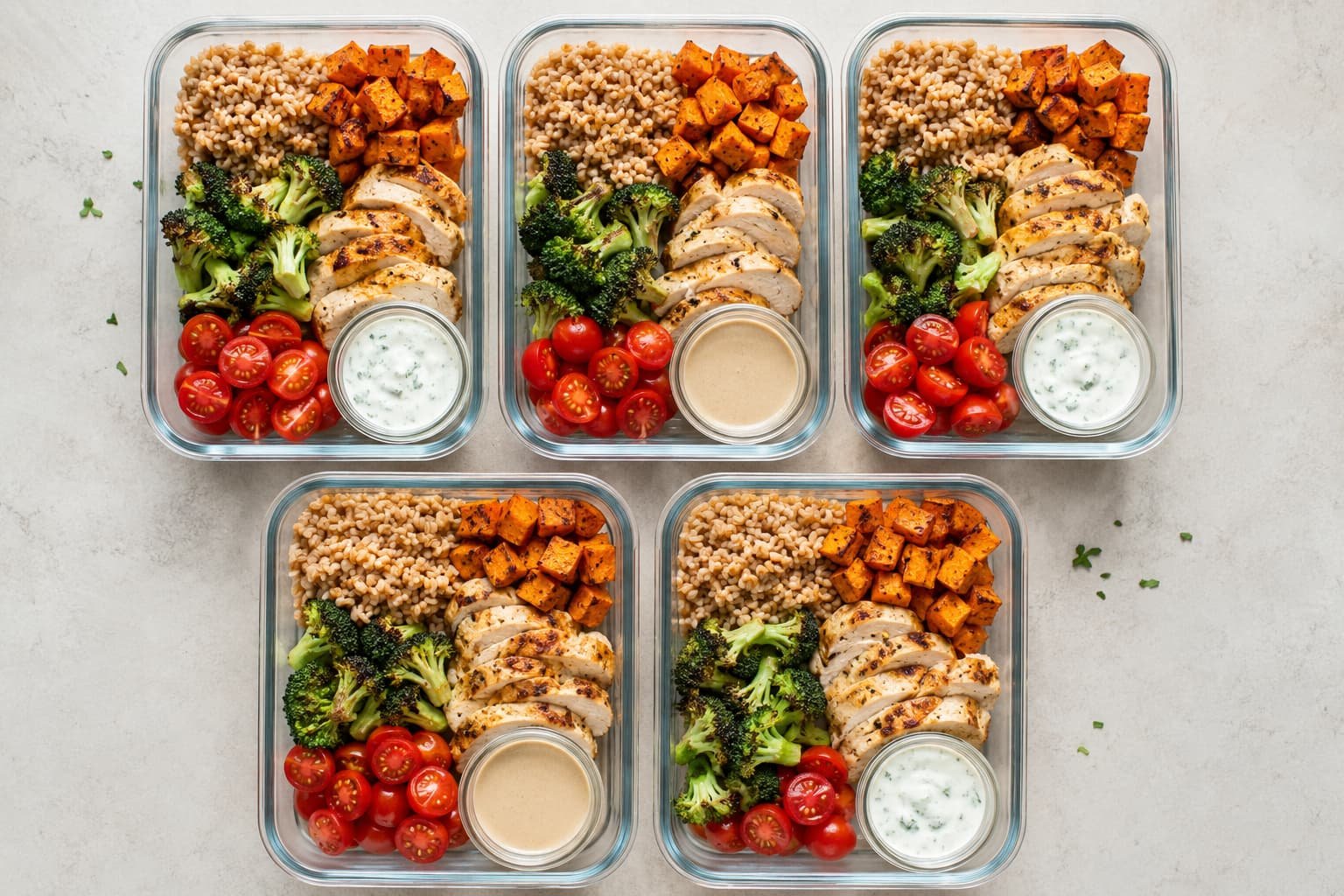
- Minute 58: Portion into the five containers. Grain on one side, protein and vegetables on the other, lids on, sauces in their own jars. Refrigerate immediately.
The Two Techniques That Decide This
The first is oven staging. Three pans cannot go in at once and come out correct, because sweet potatoes, chicken, and broccoli need 40, 24, and 20 minutes respectively. Staggering their entry so they converge on the same finish window is the entire mechanism that compresses this into an hour. Learn the order — potatoes, chicken, broccoli, spaced fifteen minutes apart — and you can substitute almost any ingredient by slotting it in according to its cook time.
Rotate each pan once at its halfway point. Ovens run 15 to 25°F hotter at the back, and an unrotated pan leaves the front row of broccoli pale while the back row chars past pleasant.
The second technique is cooling, and it is the one that separates food that is still good on Thursday from food that is not. Warm food sealed in a container generates condensation on the underside of the lid, and that water drips back onto the surface of everything below. Crisp roasted edges soften within hours. Beyond texture, food sitting between 40°F and 140°F is in the range where bacterial growth accelerates, and a sealed container of warm food takes far longer to pass through that range than an open pan.
The practical rule: nothing gets a lid until it is cool enough that the container bottom feels neutral against your palm, not warm. Spread in a single layer, that takes 7 to 10 minutes. Piled in a bowl, it takes 45.
Smaller Decisions That Improve the Week
Use glass containers, not plastic. Glass does not absorb the smoked paprika and cumin the way plastic does after three or four cycles, and it moves from refrigerator to 350°F oven without transferring anything into your food.
Store the sauces in jars small enough to fill to the top. A half-empty jar of tahini oxidizes at the surface and develops a dull, bitter skin by day three; a 4-ounce jar filled to the rim stays clean the full four days.
Keep the tomatoes out of the containers entirely and in a bowl on the counter. Refrigeration below 50°F halts the enzymes that produce tomato aroma compounds, and the flavor loss is permanent — a tomato that has spent four days in the cold does not recover on the counter.
Slice the chicken after it rests, and only once — every cut surface loses moisture in storage, so ½-inch strips hold better than dice. Never shred it: shredded chicken has the most surface area of any cut and dries fastest. And if you are short on containers, portion the grain and protein and leave the vegetables in one large box; you lose only the convenience of grabbing a single container.
Where This Goes Wrong
Everything tastes the same by Wednesday. The sauces were not actually rotated. Two sauces exist for a reason — use the tahini on the grain bowls and the yogurt on the wraps and salads, and the same components genuinely read as different meals. Using one sauce all week defeats the design.
The greens are slimy. They were dressed in advance, or packed against warm food. Salt and acid draw water out of leaf cells within about 20 minutes, and the leaves collapse. Pack the greens dry and separate, and dress the morning you eat.
The chicken is dry on day three. Either it was breast meat, or it was pulled at 165°F, or it was reheated at full microwave power. All three are avoidable, and the third is the most common.
The farro turned into a solid brick. It was stored undressed and still hot in a deep container. The tablespoon of oil tossed in while warm coats each grain and keeps them separate; without it, surface starch glues them together as they cool.
Condensation pooling in the containers. Lids went on too early. There is no fix after the fact — the water is already in the food.
Five Ways to Rotate the Week
Monday, warm grain bowl. Farro, sweet potato, broccoli, chicken, tahini sauce, a handful of spinach stirred in while the bowl is still hot so it wilts slightly.
Tuesday, wrap. Chicken and roasted vegetables in a large flour tortilla with yogurt sauce and raw spinach. Warm the tortilla for 20 seconds before rolling — a cold tortilla cracks along the fold and the wrap comes apart in your hand.
Wednesday, grain salad, served cold. Farro, halved cherry tomatoes, arugula, chicken, tahini sauce thinned with an extra tablespoon of water, plus a squeeze of fresh lemon. The cold version needs more acid than the warm one — chilled food reads as flatter, and acid compensates.
Thursday, protein plate. Skip the grain. Chicken and roasted vegetables reheated, over a large bed of dressed greens, with yogurt sauce. This is where the extra farro portion becomes optional rather than obligatory.
Swap for the next round: replace the farro with pearl couscous (8 minutes rather than 25, and a softer bite), the broccoli with cauliflower cut into 1-inch pieces, or the chicken with salmon fillets roasted 12 minutes at 425°F. Salmon is worth the substitution but only holds 2 days rather than 4 — plan it for Monday and Tuesday.
Storage and Reheating
Refrigerate at 40°F or below and eat within 4 days. Day five is where the roasted vegetables lose their remaining structure and the chicken firms noticeably.
Reheat in a microwave at 50 percent power for 2 to 3 minutes, covered with a damp paper towel. Full power drives moisture out of the chicken faster than the vegetables heat through, which is exactly the wrong outcome. Half power heats more evenly and the damp towel adds enough steam to protect the protein.
For a better result when you have 12 minutes: a 350°F oven or a toaster oven brings the roasted edges partly back. The microwave never will.
Add the sauce after reheating, not before. Tahini sauce heated in a microwave separates into oil and paste within 60 seconds, and yogurt sauce curdles outright.
The components freeze unevenly. Chicken and farro freeze well for 2 months. Roasted sweet potatoes turn watery and broccoli turns to fiber — freeze neither.
Approximate Nutrition Per Lunch
| Calories | Protein | Carbs | Fat | Fiber |
|---|---|---|---|---|
| 596 kcal | 45 g | 52 g | 23 g | 10 g |
All values are approximate estimates provided for informational purposes only and represent an average across the five lunches. Actual figures vary with portion size, sauce quantity, and substitutions.
Closing Note
The hour is not the achievement. The achievement is a refrigerator that offers you choices on Wednesday instead of an obligation, and that comes entirely from cooking components rather than meals.
Run the timeline once with a clock in front of you. The second Sunday, you will not need it.