


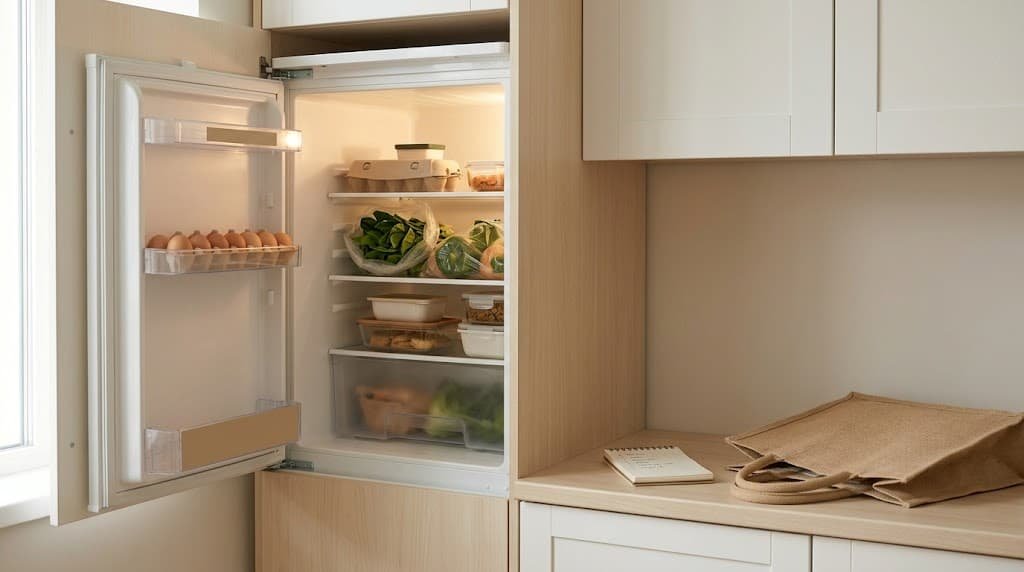
The moment this fixes is Wednesday, 6 PM, standing in front of an open fridge that has food in it — just not food that adds up to a meal without a second trip to the store. Half an onion, some rice from Sunday, three things that were bought for a recipe that never happened. The fridge is not empty. It is just full of ingredients that were never planned to be used together.
This is a fifteen-minute session, once a week, that plans meals against what a week actually contains rather than against an idealized version of it. It produces one grocery list and one trip, and the fifteen minutes is not an estimate padded for comfort — it is the actual time the steps below take once you have run them a few times.
What This Actually Buys You
Specifically: one grocery trip instead of two or three, and dinner decided before 5 PM instead of decided by whatever is fastest at 5 PM. That is the real size of the benefit, stated plainly.
It buys you the ingredient bought once instead of the same onion bought three separate times because nobody remembered whether there was one at home already. It also removes a smaller cost that rarely gets counted: the mental tally everyone in the household ends up keeping of what might or might not be in the fridge, run separately by each person who opens it. One accurate list means nobody has to hold that tally in their head at all. It removes the specific 5:30 moment of standing in front of the fridge with no plan and hunger already setting in, which is reliably when the most expensive and least satisfying dinner decisions get made. It buys back the Wednesday second trip to the store for the one thing the original plan missed, which costs far more than the ingredient itself once travel time is counted.
The recurring argument it stops, in households where this applies, is the one about what’s for dinner, asked at 5:45 with no good answer available. A plan made on Sunday means the answer already exists by the time anyone asks.
What It Won’t Fix
It will not fix a genuinely tight food budget — planning efficiently does not create money that is not there, and a fifteen-minute planning session has nothing useful to say about cost beyond preventing the specific waste of duplicate or forgotten ingredients.
It will not fix a household with several people who want completely different things for dinner every night. This system plans one meal per evening; it does not resolve a genuine mismatch in what different people are willing to eat.
It will not survive being done from memory instead of against the actual fridge and calendar. The whole method depends on looking at what is really there and what the week really contains — skip that and it becomes a wish list that does not match reality by Tuesday.
If you already know by Sunday what the week’s dinners are without writing anything down, this adds a step you do not need. It solves a specific problem — decisions made too late, under pressure, without checking what is already on hand — not a general aspiration toward better eating.
What You’ll Need
A notepad or the notes app already on your phone — nothing purpose-built. Two minutes actually standing in front of the open fridge, not recalling its contents from another room. A short list of five or six meals your household already makes without a recipe, covered in the setup steps. Fifteen minutes at a consistent point in the week, ideally right after the household’s other weekly planning if one exists, so the two feed into each other.
You do not need a meal-planning app, a recipe box, or a rotating menu template. Those solve a different problem — variety and inspiration — and bolting them onto this system usually turns fifteen minutes into forty-five without improving the actual outcome, which is one accurate list and one trip.
How to Set It Up
- Write down five or six meals your household makes regularly without consulting a recipe, ten minutes, done once. This is your base rotation — not the week’s actual plan yet, just the pool you will select from. Real meals people already cook, not aspirational ones from a cookbook nobody has opened.
- Open the fridge and freezer and write down what is already there in usable quantity, two minutes. Not everything — just proteins, and anything perishable that needs using this week specifically. This is the step that prevents buying what you already have.
- Check the coming week’s calendar for anything that changes dinner, two minutes. A late evening means a fast meal or leftovers; an evening someone is out means a smaller one. This is where the plan starts matching the actual week instead of an average one.
- Pick five dinners from the rotation, matching them to the nights that need them, five minutes. The fast meal goes on the late night. The one using tonight’s leftover chicken goes early in the week, before it stops being good. This matching step is most of what makes fifteen minutes enough — you are selecting, not inventing.
- Write the grocery list directly from what those five meals require, checked against what is already in the fridge, five minutes. Only what is missing goes on the list. This step is where most of the time savings in future weeks comes from, because a rotation of five or six meals repeats most of the same core ingredients.
- Leave two dinners of the week genuinely unplanned. Covered properly in the next section — this is not an oversight, it is the part of the system that keeps it from breaking by Wednesday.
The One Part That Decides Whether It Lasts
Whether two nights are left unplanned on purpose.
A plan for all seven nights looks more complete and fails more often. Every week contains something that displaces a planned dinner — a late meeting, a canceled plan that frees up time, leftovers from somewhere that need eating before they don’t. A fully planned week has no room to absorb that, so the displaced meal usually just gets skipped entirely, and skipped meals are exactly what sends the plan and the actual week out of sync by Wednesday. Once they are out of sync, the list stops matching what actually gets cooked, and the whole session starts to feel like it did not work.
Two open nights absorb this without touching the other five. Something runs long on Tuesday — fine, that was already the flexible night. A friend brings food over — fine, that slot was never assigned. The five planned meals stay exactly where they were, because the disruption had somewhere to land that was not one of them.
The test: by Sunday, did the week roughly match the plan, or did it drift within the first two days? If it drifted immediately, the fix is not more planning — it is leaving a third night open instead of two, because your particular week has more genuine unpredictability than the default assumes.
Small Adjustments That Help
Check the fridge before writing the rotation list, not after — knowing what is already on hand sometimes changes which of your five or six regular meals makes sense this week, and checking afterward means occasionally planning around an ingredient that quietly went bad three days ago.
Keep the rotation list somewhere visible rather than buried in a notes app folder — taped inside a cupboard door works well. A list you have to search for gets skipped in favor of picking randomly, which reintroduces the exact decision fatigue the rotation exists to remove.
Buy a genuine backup meal every week regardless of the plan — something shelf-stable that needs no fresh ingredients. This is not one of the two open nights; it is insurance for the week the open nights also get consumed by something unexpected, and it costs one extra item on a list that already exists.
Write the list in the order your specific store is laid out, not in the order items come to mind. This sounds like a small thing and it is the difference between an eight-minute trip and a fifteen-minute one, every single week, which adds up over a year to real time.
When It Falls Apart
Travel breaks it completely — there is no normal week to plan against and usually no fridge to check. Do not try to plan around a trip. Resume the session on the first regular Sunday home, and treat the return week like week one rather than trying to catch up on what was missed.
A week with a genuinely disrupted schedule — a work crunch, an illness in the household, guests staying — breaks the five-meal structure because the nights it assumed no longer apply. When this happens, drop to planning just two or three dinners instead of five, and let the rest default to the backup meal or something simple. A partial plan that matches a disrupted week is more useful than a full plan that assumes a normal one.
Running out of rotation meals — everyone is tired of the same five or six — is a different kind of failure and a sign the rotation itself needs refreshing, not that the system failed. Swap one or two meals out for something new, tested on a night that is not one of the two open ones, and let it earn its place in the rotation only if it actually gets made again without prompting.
The restart, in every case above, takes one session. There is no backlog — a missed week of planning does not compound into a harder week ten, the way a missed cleaning task might. You simply plan the coming week the same way you would have planned any other week, starting from wherever you are now.
Adapting It to Your Household
Living alone, the whole session compresses to about eight minutes, because the rotation can be shorter — three or four meals is often enough — and there is no coordination step to add.
With children who eat differently from the adults, keep one or two items in the rotation that work as a simple side for pickier eaters without becoming a second full meal to cook — plain pasta or rice alongside whatever the adults are having, rather than two separate dinners every night.
In shared housing with separate food budgets, run the fridge check and list-writing for your own shelf and section only, and keep the rotation personal rather than trying to coordinate a shared one across people who are not actually cooking together.
On shift work, anchor the session to the start of your food-shopping week rather than to a calendar day — if grocery shopping happens before the start of a work stretch regardless of which day that falls on, plan then, and the fridge-check and calendar-check steps apply exactly the same way.
With a schedule that varies significantly week to week, lean harder on the calendar-check step and expect to leave three open nights instead of two — the more genuinely unpredictable the week, the more slack the plan needs to survive contact with it.
A Simple Version to Start With
If fifteen minutes and a written rotation feels like more than you want to commit to this week, here is what actually matters.
| Do This | Time | Why It Matters Most |
|---|---|---|
| Check the fridge before shopping | 2 minutes | Prevents most of the duplicate buying on its own |
| Pick five dinners from meals you already know | 5 minutes | Removes the 5:30 decision entirely for five nights out of seven |
| Leave two nights unplanned | 0 minutes | The single reason the plan survives past Tuesday |
Skip the written rotation list and the store-layout ordering at first — those save additional minutes once the habit is established, but the three rows above are what actually stop the Wednesday-fridge problem this week.
Where to Start This Week
The case for this is specific: fifteen minutes against a real fridge and a real calendar produces one trip and five dinners already decided, instead of a week of nightly decisions made under pressure with less information than you had on Sunday.
Open the fridge right now and write down what is already there. That two-minute step, done before anything else, is what makes the rest of the list accurate instead of guessed.