


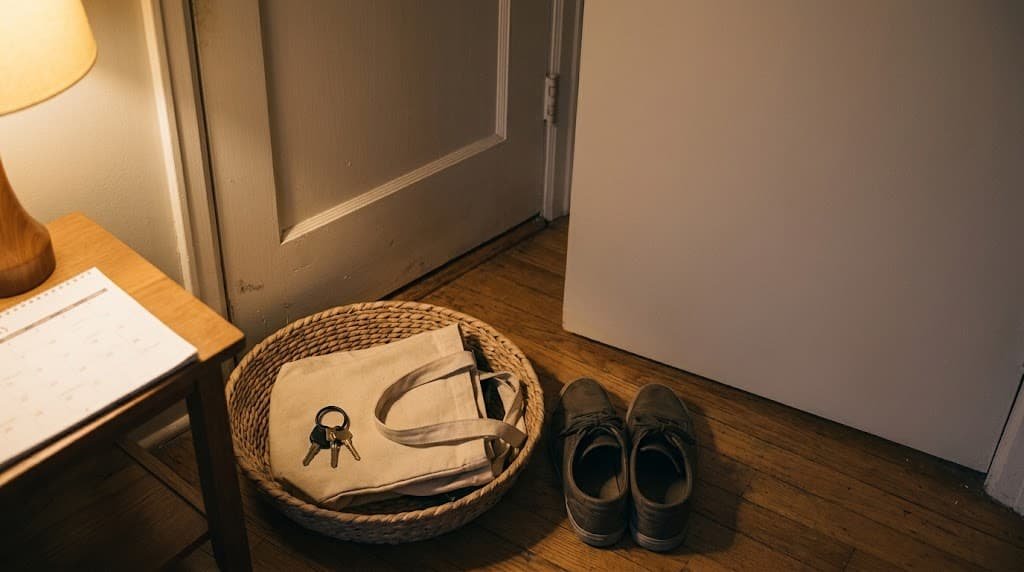
The moment this fixes is specific: standing at the door with thirty seconds to leave, looking for keys that were set down somewhere last night without thinking about it. Or the lunch that has to be made now instead of last night, or the shirt that needed ironing found out at 7:40 instead of 8:00 the night before. None of these are large problems. All of them share one cause — decisions and small tasks that got pushed to the morning, when there is the least time and patience to handle them.
An evening routine moves those specific things to the point where there is more slack to absorb them. It is fifteen minutes, done at roughly the same point every evening, and it does not make mornings effortless — it removes the handful of things that currently make them harder than they need to be.
What This Routine Actually Buys You
Concretely: somewhere between ten and fifteen minutes back in the morning, and one fewer decision made under time pressure. That is the actual size of the benefit, and it is worth stating plainly rather than inflating it.
Where those minutes come from is specific, not general. Laying out tomorrow’s clothes the night before removes a two-minute search that happens while already partly dressed. Packing a bag the night before removes the “did I forget something” walk back into the house that costs five minutes and sometimes causes you to actually forget something, because you are now doing it faster than the first time. Deciding lunch the night before removes a decision that, made at 7:50 with the fridge open, reliably takes longer than it would take at 9 PM with no other pressure attached to it.
The recurring argument it stops, in households where this applies, is usually the same one: the rushed exchange about who has the car keys, or whether the permission slip got signed, that happens every single time it gets left until the moment of leaving. Moving the decision earlier does not make the underlying logistics easier — it just moves the conversation to a time when nobody is already late.
What It Won’t Fix
It will not fix a morning that is short on time by more than fifteen minutes structurally — if the actual gap between waking and needing to leave is too tight regardless of preparation, the fix is the wake time or the schedule, not the evening routine. No amount of preparation the night before manufactures minutes that do not exist.
It will not fix a household where the friction is about coordination between people rather than preparation — who drives whom, whose turn it is, disagreements about the plan itself. Those are scheduling problems, and an evening routine has nothing to say about them.
It will not survive being done at a different time every night. The routine depends on a fixed point to anchor to, and without one it becomes another thing to remember rather than something that happens automatically.
If your mornings are currently fine and nothing specific is going wrong, this will not add anything — it solves a named problem, not a general aspiration toward order.
What You’ll Need
A basket or a shallow tray by the door — not a drawer, not a shelf, something you can see into without opening anything. A spot for tomorrow’s clothes, which can be a chair, a hook, or a hanger on the outside of the closet. Five minutes of counter space in the kitchen if lunches are part of this. Nothing else. A checklist app or a printed chart adds a step between deciding to do the routine and doing it, and for something this short, that added step is often what causes it to stop happening.
How to Set It Up
- Pick the anchor first. The moment the routine attaches to — right after the last dish is washed, right after a specific show ends, right after the youngest is in bed. It needs to be something that already happens reliably, because the routine is triggered by the anchor, not by the clock.
- Set up the basket by the door today, not tomorrow. Five minutes. Put it by the door you actually leave through — most households leave through a side or garage door, not the front, and a basket by the wrong door stays empty no matter how good the habit is elsewhere.
- Tonight, at the anchor point, do three things only: lay out tomorrow’s clothes, put bag and keys in the basket, decide lunch. Five minutes total the first time, closer to three once it is familiar. Do not add anything else on night one.
- Check the calendar for tomorrow specifically, not the week. Ten seconds. This is where an early meeting, a form due, or an appointment gets caught the night before instead of discovered at breakfast.
- Put shoes by the basket, not just the bag. This sounds trivial and is the single most skipped step, and skipping it is why people still spend two minutes looking for one shoe despite having done everything else right.
- Run it for one week exactly as written before changing anything. Not because it needs to be perfect, but because the version you build in week one is rarely the version that actually fits, and you cannot tell what to adjust until you have seen it run against a real week.
The One Part That Decides Whether It Lasts
Whether the basket is by the door you actually use.
This sounds too small to be the deciding factor, and it is the deciding factor anyway. A basket by the front door in a household that leaves through the garage gets walked past every single morning without registering, because nobody’s actual path to leaving goes near it. Within a week the basket is invisible furniture and the routine has quietly stopped, even though every other part of it — the clothes, the lunch decision, the calendar check — is still happening.
The fix is not more discipline. It is standing at your actual exit door tomorrow morning and noting exactly where your hand goes for keys, bag, or shoes, then putting the basket there — not somewhere tidier, not somewhere that looks better, exactly there. A basket in the “right” spot that nobody passes is furniture. A basket in an inconvenient spot that is directly in the exit path gets used.
Small Adjustments That Help
Put the calendar check before the clothes rather than after — a meeting discovered after you have already decided tomorrow’s outfit sometimes means redeciding it, which is exactly the kind of small friction the routine exists to remove.
Keep a spare of the one thing most often forgotten — a charger, a specific card, a form — permanently in the basket rather than relying on remembering to add it each night. One less thing to actively think about every evening.
If lunch decisions are part of this, decide from a short fixed list of four or five options rather than from scratch each night. A fixed list turns a genuine decision into a selection, and a selection takes ten seconds where a decision takes two minutes. Write the list on an index card taped inside a cupboard door rather than trying to remember it — the point is removing a decision, and a memorized list is still a decision every time you have to recall it.
Do the routine before you sit down for the evening, not after. Once you are settled, the anchor has effectively already passed, and starting the routine from a seated, relaxed position has a measurably lower completion rate than doing it while still moving.
Label the basket if more than one person uses the same entryway. A shared basket with no assigned sections turns into a pile within a week, and a pile is harder to trust at a glance than a labeled one — the whole value of the system is being able to see at a glance that everything is there, not having to dig for it.
When It Falls Apart
Travel breaks it completely, and that is expected rather than a failure — there is no basket, no fixed anchor, no ordinary evening. Restart on the first regular evening back home rather than trying to run a version of it in a hotel. Trying and failing to keep it going while away often does more damage to the habit than simply pausing it does.
A stretch of long, late work days breaks the anchor itself, because the “after dinner” or “after the show” trigger stops happening at a predictable time. When this happens, drop to the two-minute version — bag and keys in the basket, nothing else — rather than skipping the routine entirely. The two-minute version keeps the habit alive; skipping it for a week generally means rebuilding it from scratch afterward.
School holidays or a change in routine for anyone else in the household breaks the anchor in a different way — the fixed point you were using no longer happens at the same time. Pick a new anchor for the temporary period rather than trying to force the old one, and switch back once the regular schedule returns.
The restart, when any of this happens, takes about two days. One evening of doing the full version deliberately, one more evening to confirm the anchor still holds, and it is running again. There is no need for a longer recovery than that, and treating a broken routine as something requiring a fresh start from scratch is usually what makes people give up on it instead of just restarting it.
Adapting It to Your Household
Living alone, the whole routine is genuinely five minutes and the anchor can be almost anything reliable — brushing teeth, turning off the kitchen light. There is no one else’s schedule to coordinate around, which makes this the simplest version to run.
With young children, the routine roughly doubles because there are two sets of everything, and it works better done with them rather than for them — a child choosing between two shirts laid out the night before is faster in the morning than a parent choosing alone, and it removes one more morning negotiation entirely.
In shared housing with people on different schedules, keep the routine to your own items only and do not depend on a shared space staying clear — a personal basket in your own room removes the dependency on common areas being tidy, which they usually are not.
On shift work, the anchor is not evening at all — it is whatever comes before your next work period, regardless of what the clock says. Someone working nights runs this routine in the afternoon, and every step above applies unchanged; only the label “evening” is wrong for that schedule.
With an unpredictable schedule where tomorrow’s start time genuinely varies, the calendar check in step four becomes the most important part rather than the smallest — check tomorrow specifically, every night, because “usually” stops being reliable information.
In a household where more than one adult handles mornings, agree on who owns the routine before assuming it is shared. A routine with no named owner gets done by whoever happens to think of it that night, which means it happens roughly half as often as a routine with one person responsible for it — and that person can rotate weekly without losing consistency, as long as the handoff is explicit rather than assumed.
| Step | Time | Where |
|---|---|---|
| Check tomorrow’s calendar | 10 seconds | Wherever you already check it |
| Lay out clothes | 1 minute | Chair or hook, not the closet |
| Decide lunch | 30 seconds | Pick from a fixed short list |
| Bag, keys, shoes to the basket | 1–2 minutes | The door you actually exit through |
A Simple Version to Start With
If you read nothing else in this article, this is the whole system.
| Do This | When | Why It Matters Most |
|---|---|---|
| Put a basket by your real exit door | Once, today | Everything else depends on this being in the right spot |
| Bag, keys, shoes into the basket | Every evening, one fixed anchor point | This alone recovers most of the ten minutes |
| Glance at tomorrow’s calendar | Same time, 10 seconds | Catches the one thing that would otherwise surprise you at breakfast |
If a full evening feels like too much to commit to tonight, run only the second row for a week — bag, keys, and shoes into a basket by the door you actually use. It is a smaller version of the same mechanism, and it is still enough to feel the difference by Thursday.
Where to Start Tonight
This routine earns its place for one narrow reason: it moves a handful of specific small decisions from the worst possible time to make them to a better one. It will not make mornings effortless, and it is not trying to.
Tonight, put a basket by the door you actually leave through, and put tomorrow’s keys and bag in it before you sit down for the evening. That one action is worth doing even before anything else on this list.