


A pantry rarely falls apart during the week. It falls apart in the ten minutes after grocery shopping, when six bags are sitting on the counter, everything is melting or getting warm, and the fastest thing to do with a new box of pasta is shove it wherever there is a gap — on top of the old box, behind something else, wherever it fits. That single ten-minute window, repeated weekly, is what actually determines whether a pantry stays organized or slowly reverts to chaos.
This is a system built around that specific moment — designed so restocking after a shopping trip is as easy as the daily grabbing of a snack, rather than a chore that gets rushed and undoes the organization every single week. The full setup takes an afternoon; the habit that protects it afterward takes one extra second per item, every time groceries come home.
Why This System Actually Works
Most pantry organizing advice focuses entirely on how items are arranged for daily use — labeled bins, category zones, everything facing forward — and that part matters, but it solves only half the problem. The other half is what happens when new groceries arrive, and if the system makes restocking slow or effortful, restocking is exactly the moment when the careful arrangement gets abandoned in favor of speed.
The fix is a rotation habit borrowed directly from how grocery stores stock their own shelves: new items go to the back, existing items get pulled forward. This is called FIFO — first in, first out — and it solves two problems simultaneously. It keeps older items visible and gets used before they expire, and it gives restocking a simple, non-negotiable rule instead of a judgment call about where each new item should go. Grocery stores rely on this same principle at a much larger scale for exactly the same reason: a system that requires a fresh decision for every item breaks down under volume, while a fixed rule does not.
What You’ll Need
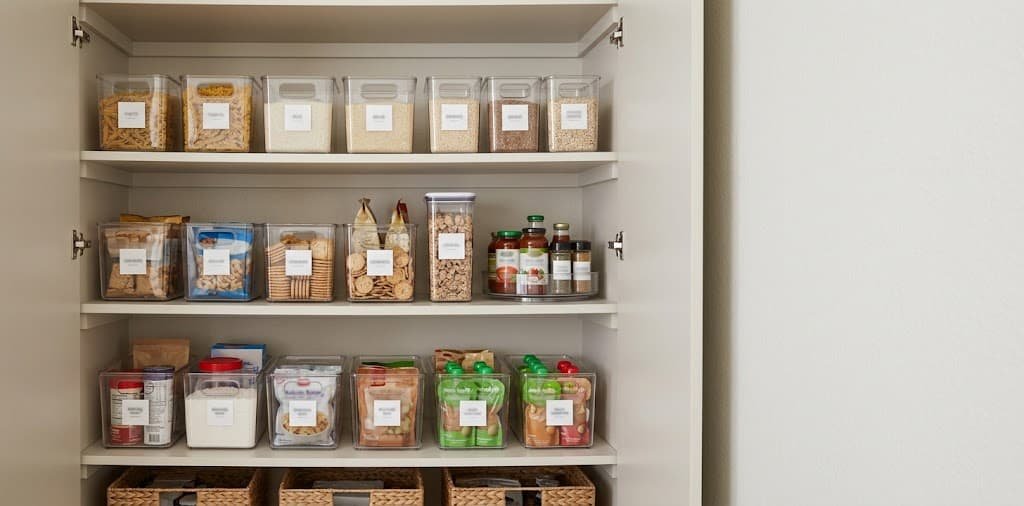
- Clear, uniform bins for loose or bulky dry goods — rice, flour, pasta, snacks — sized to fit your specific shelf depth, since uniform bins are what makes the front-to-back rotation in Section 5 physically possible.
- A turntable or lazy Susan for the corner or back of any deep shelf, since deep shelves are where items reliably get pushed to the back and forgotten, and a turntable brings the back within reach without needing to remove everything in front of it.
- Shelf risers or small stacking racks for canned goods, so cans can be arranged in visible rows rather than stacked in a way that hides everything but the top layer.
- A permanent marker or a roll of masking tape for dating anything you decant into a bin, since removing an item from its original packaging also removes its printed expiration date.
How to Do It, Step by Step
- Remove everything from the pantry and check dates as you go, discarding anything expired. This is the only point in the process where checking every item costs no extra time, since everything is already out and in hand.
- Group items into a small number of broad categories — grains and pasta, canned goods, snacks, baking, breakfast — rather than many narrow ones. Pantry items, unlike clothing or bathroom products, genuinely map well to category-based grouping, since that is how groceries are bought and how most people look for them. This is the one place in the whole system where category sorting is actually the right call, not a fallback.
- Assign each category a specific shelf or zone, with the most frequently used categories at eye level and less frequent ones — baking supplies, specialty items — on higher or lower shelves.
- Decant loose or bulky dry goods into the uniform bins, labeling and dating each one as you go. Uniform bins are what makes rows readable at a glance and what makes the front-to-back rotation in the next step physically possible.
- Load everything with the oldest items at the front and the newest toward the back, facing labels outward so the category and contents are visible without pulling anything forward.
- The next time you put groceries away, follow one rule without exception: new items go behind existing ones of the same type, always. This single rule is what the whole system depends on, and it is covered in full in the next section.
The One Thing That Actually Makes This Work
The front-to-back rotation rule, applied specifically during restocking after grocery shopping, is what determines whether this pantry stays organized for months or reverts to chaos within a few weeks.
Every other part of this system — the bins, the categories, the labels — degrades gracefully even if it slips slightly. A category with a mislabeled bin is still roughly organized. But a broken rotation habit compounds specifically because it happens at the exact moment speed is most tempting: arms full of groceries, other items still waiting on the counter, and putting the new box of crackers in front of the old one takes one second less than reaching behind it. That one second, repeated weekly, is the entire difference between a pantry that stays organized and one that needs a full redo every few months.
The habit is small enough to actually maintain specifically because it does not require reorganizing anything else. It is a single rule applied at a single moment — new goes behind old — and it needs no ongoing decision-making once it becomes automatic, which is why it succeeds where more elaborate systems requiring a fresh judgment call for every item tend to break down.
Practical Tips
Do a five-minute pantry check before every grocery trip, not after — knowing what is already at the front of each category prevents buying duplicates of something you already have plenty of, which is one of the more common sources of pantry overcrowding.
Keep a running list on the inside of the pantry door of items that are getting low, updated the moment you notice rather than trying to remember at the store — this turns restocking from a guessing exercise into a simple checklist.
Store the heaviest and most frequently used items — flour, rice, oil — at a comfortable mid-height rather than a high shelf, since anything genuinely heavy stored above shoulder height gets avoided or handled awkwardly, which works against the whole system regardless of how well categorized it is.
Mistakes to Watch Out For
Abandoning the front-to-back rule specifically during a rushed restock is the most common and most damaging mistake — covered in depth above, and it is worth naming again here because it is the single point of failure this entire system is built to prevent. There is no version of this system that survives skipping this rule regularly, no matter how good the initial setup was.
Over-categorizing into too many narrow zones is the second common mistake — a dozen tightly defined categories look impressive on day one and become a maze of micro-decisions during a rushed restock, which is exactly the moment the system needs to be simplest, not most detailed.
Forgetting to date decanted items is the third — a bin of rice or flour with no visible date looks identical whether it went in last week or eight months ago, and losing that information defeats the rotation system’s actual purpose, which is keeping older items moving before they go stale or expire unnoticed.
Budget Breakdown
Budget tier: Repurposed jars and containers you already own for decanting, plain masking tape for labels, and category grouping using existing shelves with no new hardware. This captures the entire rotation benefit at essentially no cost.
Mid-range tier: A matched set of clear stackable bins sized to your specific shelves, a turntable for the deepest corner, and printed labels rather than handwritten tape. This is the version that makes the daily visual experience noticeably better while keeping the rotation system fully intact.
Higher-investment tier: Pull-out shelving inserts for a deep pantry, under-shelf wire racks that double usable vertical space per shelf, and a dedicated small chalkboard or whiteboard for the running shopping list from the tips section — worth it specifically for a larger household going through groceries quickly enough that restocking happens multiple times a week.
Adjusting It for Your Pantry
In a small pantry or single cabinet rather than a walk-in space, compress the category list to the four or five broadest groupings and skip the turntable, since a small footprint rarely has a genuinely deep corner that needs one — the rotation rule matters just as much here, only applied across fewer, larger zones.
In a household that shops multiple times a week rather than in one large weekly trip, the rotation rule matters even more than in a once-weekly household, since restocking happens more often and each instance is another opportunity for the habit to either hold or slip.
In a shared kitchen with several people restocking independently, write the front-to-back rule somewhere visible inside the pantry itself, since a rule that lives only in one person’s head reliably breaks down the first time someone else puts groceries away without knowing it.
Keeping It Organized
Do a two-minute front-facing pass weekly — pulling any items that have drifted out of rotation order back into place — rather than waiting for a full visible mess to prompt a bigger cleanup.
Reassess the category zones every few months, since shopping habits shift with the seasons, and a zone sized for summer snacking might not fit winter baking supplies without some adjustment.
Where to Start
The honest case for this system is specific: a pantry that stays organized is not the result of a better initial setup, it is the result of one rule applied consistently at the one moment — restocking — when disorganization actually gets introduced.
Empty and sort the pantry this weekend, and commit to the front-to-back rule starting with your very next grocery trip. That single habit, more than any bin or label, is what keeps this system working months from now, well after the initial reorganizing effort has been forgotten.