


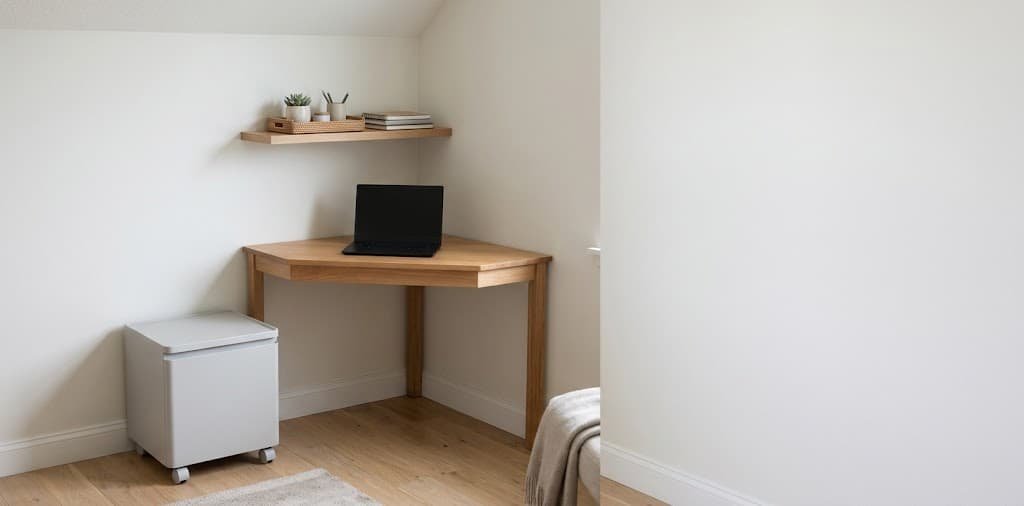
A corner office lives inside a shared room — a living room, a bedroom, sometimes a wide hallway — which means it has to do something a real office never has to: disappear convincingly at the end of the workday. A dedicated office room can stay visibly messy behind a closed door with no real cost. A corner desk that stays messy is now part of the living room’s permanent visual clutter, every evening, whether anyone is working or not.
This is a system built around that constraint specifically — organizing a corner workspace so it functions well during work hours and genuinely recedes into the room once the day is done. The setup itself takes an afternoon; the daily habit that keeps it working after that takes under a minute.
Why This System Actually Works
Most corner office setups fail for a footprint reason before they fail for an organization reason: a corner is not a rectangle, it is two walls meeting at an angle, and furniture designed for a straight wall wastes a meaningful triangular wedge of usable space right at the point where the walls meet. The fix starts with furniture shaped for the actual corner, not furniture borrowed from a straight-wall setup and pushed into an angle it was never designed for.
The second failure point is visibility. A desk with no closing mechanism — no way to contain cables, papers, and the day’s clutter — stays visible to the entire room permanently, and a workspace visible at all times, whether in use or not, reads to everyone in the room as ongoing clutter rather than a functioning office. Solving both the footprint and the visibility problem together is what makes a corner office actually work in a shared space, and neither problem solved alone produces a setup that genuinely holds up.
What You’ll Need
- A corner-specific desk, or a compact straight desk sized to fit the shorter of the two walls — measure both walls of the corner before buying anything, since corner desks vary significantly in how deep they project into the room.
- A vertical storage solution — wall shelving or a pegboard — since a corner’s floor footprint is fixed and small, and the wall space directly above the desk is the only genuinely expandable storage this setup has.
- A cable management tray or clips, mounted under the desk, since a corner setup typically has more visible cable runs than a straight-wall desk due to the angle.
- One closed-lid box or a slim rolling cart with a cover for the end-of-day reset covered in Section 5 — this is the single piece of equipment the whole containment system depends on.
How to Do It, Step by Step
- Measure both walls of the corner and the depth available before furniture would block foot traffic through the room. This determines whether a true corner desk fits or whether a smaller straight desk against the shorter wall is the more realistic choice.
- Position the desk so cables can run down and along the nearest wall, not across open floor space. A cable crossing the visible floor is both a trip hazard and the single most common reason a corner office looks messy even when the desk itself is clean.
- Mount vertical storage directly above the desk, within arm’s reach while seated. This is where daily-use items live, since the desk surface itself needs to stay clear enough to actually work on and clear enough to reset quickly at day’s end.
- Route and secure all cables using the under-desk tray or clips before anything else goes on the desk surface. Cable management done first is dramatically easier than cable management attempted around equipment that is already in place.
- Set up the closed-lid box or covered cart beside the desk, and designate it as the single place everything goes at the end of each work session — papers, chargers, anything not permanently mounted to the wall storage.
- Do a real end-of-day reset today, not tomorrow, to confirm the system actually works before treating it as finished. If something does not have an obvious place to go during this first reset, that is the gap to solve now rather than discovering it repeatedly every evening.
The One Thing That Actually Makes This Work
A genuine end-of-day reset — everything not permanently wall-mounted goes into the closed box or under the cover, every single day — is what determines whether this corner reads as a functioning office or as permanent clutter to everyone else sharing the room.
Without a defined reset, the desk accumulates the normal small residue of a workday — a coffee mug, loose papers, a laptop left open — and because the desk sits in a shared space, that residue is visible to everyone in the room at all hours, not just during work. Over a few weeks this visible accumulation is what makes a corner office start to feel like clutter had actually taken over the room, even if the underlying organization system is otherwise sound.
The reset works specifically because it has one destination, not several. A reset that asks “where does this go” for each item individually takes too long to become a genuine daily habit; a reset that asks only “into the box or not” takes under a minute and actually happens every evening rather than being skipped on busy days.
Practical Tips
Choose a desk color and finish that matches the surrounding room’s existing furniture rather than treating the corner as a separate zone with its own look — a desk that visually blends with the room reads as much less intrusive even before anything is organized on top of it.
Keep the wall storage shallow rather than deep, since a corner desk area is usually viewed from an angle by anyone walking through the room, and deep shelving reads visually heavier and more cluttered from that angle than the same items on a shallow shelf would.
If video calls happen at this desk, position the vertical storage and any visible cables outside the camera’s typical frame, since what looks acceptable in person can look considerably more cluttered on a video call where the camera crops tightly around the desk area.
Mistakes to Watch Out For
Buying a straight-wall desk and simply angling it into the corner is the most common mistake — it wastes the triangular wedge of space right at the corner point and typically leaves an awkward gap behind the desk that becomes its own small clutter zone, defeating the purpose of choosing a corner in the first place.
Skipping cable management because it feels like the least urgent step is the second common mistake — visible tangled cables are one of the fastest ways a corner desk reads as cluttered even when every other surface is genuinely clean, precisely because cables draw the eye in a way that a stack of papers does not.
Treating the end-of-day reset as optional on busy days is the third — this is precisely when skipping it does the most damage, since a corner office in a shared room stays visible to everyone else in the household regardless of how the workday went, and the days you are too busy to reset are usually also the days the desk needed it most.
Budget Breakdown
Budget tier: An existing small table repositioned into the corner, one wall-mounted shelf, and a repurposed box with a lid for the end-of-day reset. This addresses the core footprint and containment needs with almost no new spending.
Mid-range tier: A purpose-built corner desk sized to the actual measured space, proper under-desk cable management, and a matching closed storage cart. This is the version that genuinely solves both the footprint problem and the visibility problem the system is built around.
Higher-investment tier: A corner desk with built-in cable routing and a monitor arm to free up desk surface, plus a wall-mounted fold-down section for anything used only occasionally, maximizing the vertical space beyond what standard shelving alone can capture.
Adjusting It for Your Space
In a shared bedroom corner, prioritize the closed-lid box even more heavily than in a living room setup, since a visible workspace in a room meant for rest works against winding down at the end of the day — the physical act of closing the box functions as a genuine signal that work has ended.
In a small apartment where the corner desk shares space with dining or another daily function, choose a desk with a genuinely closable or foldable design, since the space needs to fully convert between functions rather than simply being reset to tidy.
In a corner with limited natural light, prioritize a small task lamp mounted to the wall storage over relying on ceiling light alone, since a dim corner desk gets avoided regardless of how well the rest of the system is organized.
Keeping It Organized
Protect the daily reset as an actual step in your closing-up routine, not an afterthought — attaching it to something you already do at the end of the day, like closing the laptop, makes it far more likely to happen consistently than treating it as a separate task to remember.
Reassess the wall storage contents monthly, since items that felt essential when the system was set up sometimes stop being used regularly, and an item taking up arm’s-reach shelf space without earning its spot is worth relocating.
Where to Start
The honest case for this system is specific: a corner desk that resets in under a minute stays a functioning office rather than becoming permanent clutter in a room that has to serve other purposes too.
Measure your corner today, and set up the closed box before anything else. That single container, used consistently every evening, does more to keep the space workable than any shelf or desk choice that follows it.