


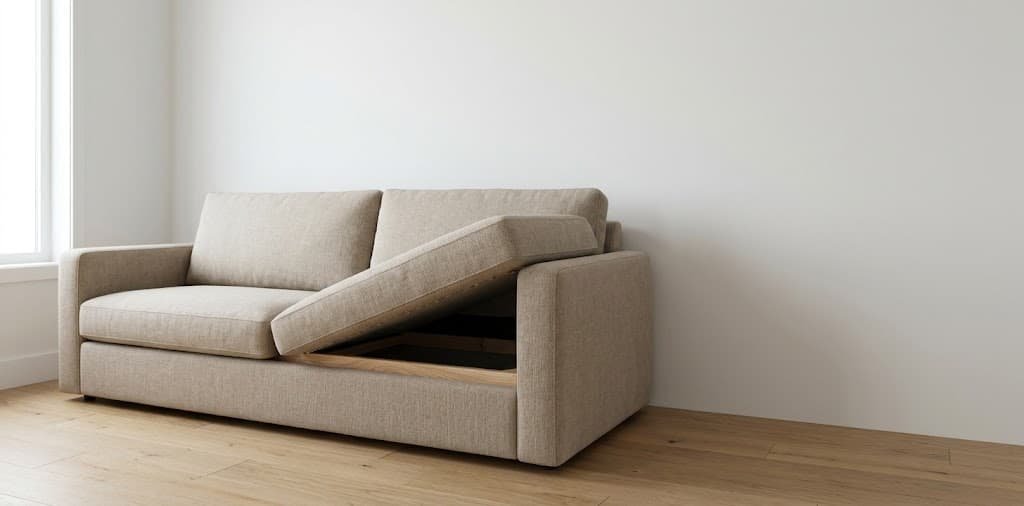
Sit on two sofas in the same showroom, both upholstered in nearly identical fabric, both priced within a hundred dollars of each other, and you would struggle to tell which one will still hold its shape in five years and which one will be sagging in the middle by year two. The difference is not visible from the outside. It is buried inside the frame, the suspension, and the cushion fill — three components no showroom label ever mentions and almost no buyer thinks to ask about.
This guide is built around those three hidden components, since they determine a sofa’s actual lifespan far more than the fabric, the color, or the silhouette that gets all the attention in a showroom.
Why This Matters More Than It Looks Like It Should
A sofa is not really one object — it is a frame doing structural work, a suspension system doing the work of supporting weight without sagging, and cushions doing the work of comfort, all wrapped in fabric that shows none of it. Fabric can be reupholstered. A broken frame or a suspension system that has lost its tension generally cannot be fixed without a cost approaching a full replacement.
This is why two sofas that look nearly identical and cost about the same can have wildly different lifespans — the visible 90 percent of the sofa, the fabric and the silhouette, tells you almost nothing about the invisible 10 percent actually holding it together.
What You’ll Need to Evaluate a Sofa Properly
- A willingness to ask the salesperson specific questions about frame material and construction — most showrooms have this information available even when it is not printed on the tag, and asking directly is the only reliable way to get it.
- Fifteen minutes actually sitting and moving on the sofa, not just perching for thirty seconds — several of the checks below only reveal themselves once you have shifted your weight around and pressed on the frame directly.
- A tape measure, since cushion and seat depth matter more to daily comfort than most buyers expect, and eyeballing it in a showroom is unreliable.
How to Actually Evaluate One, Step by Step
- Ask specifically what the frame is made of. Kiln-dried hardwood is the standard for genuine durability. Softwood or particleboard frames are common at lower price points and are the single most common reason a budget sofa fails within a few years — not from fabric wear, but from the frame itself flexing and eventually cracking under repeated weight.
- Press firmly on the arm and the frame near the base while the sofa is unoccupied. A solid hardwood frame gives almost nothing under this pressure. A frame that flexes or creaks noticeably is telling you something the fabric will never reveal.
- Ask about the suspension system underneath the cushions — eight-way hand-tied springs are the traditional high-durability standard, sinuous (zigzag) wire springs are a common and reasonably durable mid-tier option, and webbing alone, with no springs at all, is the least durable and most common at the lowest price points.
- Sit toward the front edge of a cushion, not the center, and shift your weight side to side. A well-built suspension system feels evenly supportive across the whole seat width. One that feels noticeably softer or bouncier at the edges is a weaker system than one that feels consistent everywhere you sit.
- Ask what the seat cushions are filled with, and press directly on a cushion with your palm to see how quickly it recovers its shape. High-resiliency foam or a foam core wrapped in down recovers its shape within a few seconds. Low-density foam stays compressed noticeably longer, which is an early preview of how it will look after a year of daily sitting.
- Check the fabric’s rub count, sometimes called a Martindale rating, if it is available, since this number indicates how many rubbing cycles the fabric withstands before visible wear — genuinely useful for comparing two fabric options on the same frame, though it says nothing about the frame or suspension underneath.
The Detail That Actually Decides This
Frame joinery — specifically whether the frame’s joints are doweled and glued or simply stapled and glued — matters more to long-term durability than almost anything else on this list, and it is the detail buyers are least likely to think to ask about.
A dowel joint interlocks two pieces of wood with a wooden peg before gluing, distributing stress across a larger surface area and holding under years of repeated flexing from people sitting down and standing up. A stapled joint relies entirely on the staple and a thin layer of glue holding two flat surfaces together, and under the same repeated stress, staples work loose gradually, which is precisely why a sofa that felt perfectly solid in the showroom can develop an audible creak or a slight wobble within a year or two of home use.
This detail is almost never visible without disassembling the sofa, which means it has to be asked about directly. A reputable retailer or manufacturer will generally know and disclose this when asked plainly; hesitation or a vague answer to a direct question about frame joinery is itself useful information about how much the seller actually knows about their own product’s construction.
Practical Notes Worth Knowing
Sit-test a floor model that has already had real showroom traffic, not just the freshest one on display, if the option exists — a sofa that has absorbed months of customers sitting on it shows you something closer to its two-year condition than a pristine model does.
Down-wrapped foam cushions feel exceptional in a showroom and require more regular fluffing and maintenance at home than solid foam does — a genuinely different ongoing commitment than the showroom feel suggests, and worth knowing before falling for that initial impression.
A removable, washable cushion cover extends a sofa’s practical lifespan considerably more than most buyers weigh it, since staining is one of the more common reasons a structurally sound sofa gets replaced early — the frame and suspension may be fine while the fabric alone forces a decision to replace it.
Common Regrets and Mistakes Buyers Make
Choosing based entirely on how a sofa feels in a fifteen-minute showroom visit is the most common mistake — a soft, plush initial feel and long-term supportive comfort are not the same quality, and the softest cushion in the showroom is sometimes the one that loses its shape fastest at home.
Not asking about frame material or joinery at all, simply assuming a sofa in a reputable store is automatically well built, is the second common mistake — construction quality varies enormously even within a single retailer’s own lineup, and price alone is an unreliable guide to which specific model in front of you got the better construction.
Underestimating how much a household’s actual use — kids, pets, daily heavy use versus occasional guest seating — should change which construction tier is worth paying for is the third. A sofa built for occasional light use in a formal living room does not need to survive what a sofa in an active family room needs to survive, and buying for the wrong use case wastes money in either direction.
Where the Investment Actually Matters
At the budget tier, expect webbing suspension, softwood or particleboard framing, and standard-density foam — genuinely fine for light, occasional use, and a reasonable choice for a guest room or a household not putting daily heavy wear on the piece.
At the mid-range tier, sinuous spring suspension and kiln-dried hardwood framing become standard, along with higher-density foam or foam-wrapped cushions — this tier is where most households doing genuine daily use should be looking, since it is where the frame and suspension components actually built for years of real use begin appearing consistently.
At the higher-investment tier, eight-way hand-tied springs, doweled and glued joinery, and down-wrapped or down-blend cushions represent the traditional high-durability standard — worth it specifically for a primary living room sofa expected to last a decade or more under daily family use, where the cost difference amortizes over meaningfully more years of service.
Choosing for Your Actual Household
With young children or pets in daily contact with the sofa, prioritize a durable, tightly woven performance fabric with a high rub count over a delicate natural fiber, regardless of how the softer fabric feels initially — fabric durability matters disproportionately more in this specific household than in one without daily heavy contact.
In a smaller living room where the sofa gets used constantly as the primary seating, prioritize the suspension and frame quality from the mid-range tier at minimum, since a smaller room typically means the same sofa absorbs more hours of daily use than an equivalent piece in a larger home with multiple seating areas to distribute wear across.
For a sofa intended mainly for occasional guests or a rarely used formal space, the budget tier is a genuinely reasonable choice rather than a compromise, since the components that fail under repeated daily stress are simply never stressed that way in this use case.
Keeping It in Good Shape
Rotate and flip loose cushions regularly, if they are reversible, to distribute wear evenly rather than letting the same face and the same seating spot absorb all the compression over time.
Vacuum upholstery and check for loose threads or early joint creaks every few months, since catching a minor issue — a loosening leg, a slightly separated seam — early is meaningfully easier and cheaper to address than waiting until it becomes a structural problem.
Where to Start Looking
The honest case here is simple: the frame, the suspension, and the joinery — three things you cannot see and have to ask about directly — determine a sofa’s real lifespan far more than the fabric or the silhouette that gets all the showroom attention.
Before buying, ask the retailer three direct questions: what is the frame made of, how is it joined, and what suspension system is underneath the cushions. Those three answers tell you more about what you are actually paying for than any amount of sitting and admiring the fabric.