


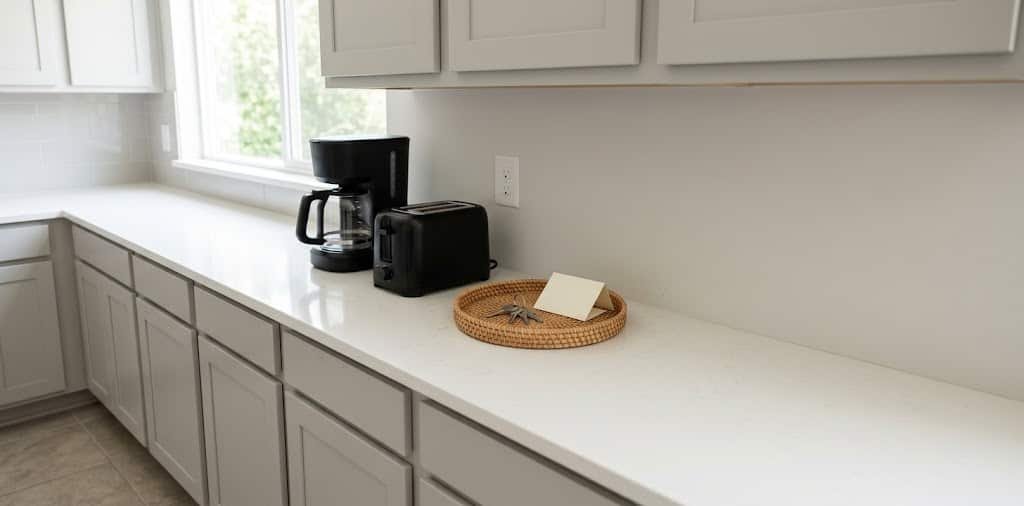
Look closely at a cluttered kitchen counter and you will usually find it is not the toaster or the coffee maker doing the damage — those earn their spot through daily use. It is the mail that landed there Tuesday, the receipt from Thursday, the single sock, the phone charger, the thing you set down “for a second” that has now been there for three weeks. Counter clutter is almost never about having too many kitchen items. It is about having too many orphan items with no designated home.
This is a system built around that distinction — separating what genuinely belongs on the counter permanently from everything else that is only there because it never got assigned a real home. The whole first pass takes about twenty minutes, and the ongoing maintenance after that takes seconds a day rather than a recurring cleaning project.
Why This System Actually Works
A counter with no rule for what belongs on it accepts everything by default, because setting something down takes no thought and finding its actual home takes a decision. Over weeks, the path of least resistance wins, and the counter fills with items that each individually made sense to set down in the moment and collectively add up to visual chaos.
The fix is not a bigger cleaning effort — it is a smaller, clearer rule: nothing lives on the counter unless it is used at least once daily and returns to the counter after each use. Everything else gets a specific home somewhere else in the kitchen, even if that home is a single drawer. This single rule does more work than any organizing product, because it turns “should this be here” from a judgment call into a simple daily-use test. A judgment call gets relitigated every time you look at the item; a test with a clear pass-or-fail answer does not.
What You’ll Need
- One shallow tray or basket for the counter’s designated catch-all — a single spot for the handful of small items that genuinely need to be grabbed quickly, rather than letting them scatter across the whole surface.
- A drawer or cabinet with available space to become the new home for anything currently on the counter that fails the daily-use test.
- A timer or just your phone, since the first full reset takes about 20 minutes and having a visible countdown keeps the task from expanding to fill the whole afternoon.
- Nothing to purchase for the core system. Storage bins and organizers help later, covered in the budget section, but the first pass uses only what your kitchen already has.
How to Do It, Step by Step
- Clear the entire counter onto the kitchen table, sorting nothing yet. Seeing everything together, all at once, is what makes the daily-use test in the next step actually work — sorting item by item as you go makes it too easy to justify keeping something out of habit rather than genuine need.
- Wipe down the empty counter completely. A clean surface changes how you evaluate what goes back — it is genuinely harder to set clutter down on a visibly clean counter than on one that already has three other things sitting on it.
- Apply the daily-use test to every single item: does this get used at least once a day, and does it return to the counter after each use? Coffee maker, yes. A stand mixer used twice a month, no, regardless of how heavy it is to move.
- Items that pass go back onto the counter immediately, positioned near where they actually get used — the coffee maker near the water source, the toaster near an outlet, not wherever there happens to be space.
- Items that fail get a specific new home right now, not “somewhere later.” Open a drawer or cabinet and assign the item a spot on the spot, even if that spot is not perfect. An imperfect assigned home beats no home at all.
- Whatever remains — the true orphans with no obvious kitchen home — goes into the single tray from your supply list, and nowhere else on the counter. This tray becomes the one exception to the “cleared counter” rule, and confining orphans to one spot prevents them from spreading back across the whole surface.
The One Thing That Actually Makes This Work
Confining every unsorted, undecided item to the single tray, and only the tray, is what prevents this system from quietly reverting to a cluttered counter within a month.
Without a single defined landing spot, an item without an obvious home gets set down wherever there is a free inch of counter space, and that one item becomes the anchor that makes setting down a second item feel normal, and then a third. The tray interrupts that pattern by giving every ownerless item exactly one place to go, which means the rest of the counter stays visibly, consistently clear even on a genuinely busy day.
The tray needs a hard limit to keep working — when it is full, emptying it becomes the task, not finding more counter space around it. A tray that is allowed to overflow onto the surrounding counter has stopped functioning as a boundary and become just another cluttered zone with a basket in the middle of it. A smaller tray than feels necessary at first is usually the right size, precisely because it forces the emptying habit rather than accommodating weeks of accumulation.
Practical Tips
Keep the tray small enough that it visibly fills up within a few days of normal use — a large tray takes weeks to feel full, which delays the moment you actually deal with what is in it.
Do the daily-use test honestly rather than sentimentally. An appliance you love in theory but reach for twice a year fails the test regardless of how much you like owning it, and keeping it on the counter anyway is exactly the kind of exception that erodes the whole system.
Assign specific homes for the most common recurring orphans — mail, keys, a phone charger — in a spot outside the kitchen entirely if possible, since a kitchen counter is rarely the ideal home for any of these even though it is where they most often land by default.
Mistakes to Watch Out For
Reorganizing without actually removing anything is the most common mistake — rearranging clutter into a neater-looking arrangement addresses the visual symptom for a day or two while leaving the actual problem, too many items with no assigned home, completely intact. The counter looks better in a photo taken immediately afterward and looks exactly the same as before within a week.
Skipping the full-clear step and sorting item by item while everything is still on the counter is the second common mistake — it is far easier to talk yourself into keeping something in place when it is not competing for attention against everything else at once.
Letting the catch-all tray grow into a second tray, then a third, is the third — the tray only works as a genuine boundary because there is exactly one, and doubling it quietly re-legitimizes counter clutter under a slightly tidier name.
Budget Breakdown
Budget tier: A single tray or shallow basket you already own, plus reassigning existing drawer space for relocated items. This costs nothing and captures nearly the entire benefit of the system on its own, since the daily-use rule itself, not any product, is doing most of the actual work.
Mid-range tier: A drawer organizer insert for the newly assigned storage drawer, plus a slightly nicer designated tray that matches your kitchen’s look, since it is now a permanent visible fixture rather than a temporary catch-all.
Higher-investment tier: A small dedicated cabinet or appliance garage — a cabinet with a roll-up or lift door — specifically for appliances that pass the daily-use test but that you would still prefer not visible when not actively in use, such as a stand mixer used most mornings but not wanted as permanent visual clutter.
Adjusting It for Your Kitchen
In a small kitchen with limited drawer and cabinet space, the daily-use test needs to be applied more strictly than in a larger kitchen — when storage is genuinely scarce, “used a few times a week” fails the test even though it would pass in a kitchen with more room to spare, simply because counter space is the more limited resource.
In a shared kitchen with multiple people cooking regularly, agree on the daily-use list together rather than one person deciding unilaterally, since what counts as daily use genuinely differs between people, and a system imposed by only one household member erodes faster without shared buy-in from everyone using the space.
In a kitchen that doubles as a mail and homework landing zone by necessity, designate a specific counter section — not the whole counter — for that purpose explicitly, rather than letting it compete with the daily-use appliances for the same undefined space.
Keeping It Decluttered
Empty the catch-all tray at the same point every day — end of dinner cleanup works well for most households — rather than waiting until it visibly overflows. A tray emptied daily takes thirty seconds; one left to fill up becomes its own small sorting project, which is exactly the kind of task this whole system was built to eliminate in the first place.
Reapply the full daily-use test every few months, since what actually gets used daily shifts with the seasons and with changes in routine, and an item that passed the test in summer sometimes quietly fails it by winter without anyone noticing the shift.
Where to Start
The honest case for this system is narrow and specific: a counter holding only what you actually use daily, plus one contained tray for everything else, stays clear with almost no ongoing effort — because there is nowhere else for clutter to accumulate.
Clear the whole counter today, apply the daily-use test item by item, and confine everything undecided to one tray. That single pass, done once, is most of the work this system requires.