

Most bathroom cabinets are organized by product type — all the skincare together, all the medications together, all the hair products together — which looks logical on a shelf and works badly at 7 AM, because your actual morning does not move through the cabinet by category. It moves through a sequence: wash, then treat, then style, then anything else. A cabinet organized by category makes you hunt across three different shelves for the four things you use in order every single day.
This is a system built around that sequence instead — arranging the cabinet to match the order you actually move through your routine, so your hand reaches the right shelf without thinking, in the same order every morning. The whole reorganization takes about thirty minutes, and the payoff is measured in seconds saved daily, which compounds into real time across a year of mornings.
Why This System Actually Works
A morning routine is not really a set of items — it is a sequence of steps performed in a fairly consistent order, and the friction in a badly organized cabinet comes specifically from that sequence not matching the physical layout. Reaching for the moisturizer on the bottom shelf right after washing your face on the top shelf, then reaching back up for something else, adds small physical detours that individually cost seconds and collectively cost real morning time.
Arranging shelves top to bottom or front to back in the actual order of use turns the routine into one continuous motion rather than a search — you finish one step and the next item is already exactly where your hand goes next, because that is where it was placed on purpose. A category-organized cabinet requires remembering where things are; a sequence-organized cabinet requires only remembering the next physical motion, which is a lower cognitive load especially at 7 AM.
What You’ll Need
- Small bins or trays sized to your specific cabinet shelves, since most cabinet shelves are too deep or too tall to use efficiently without something to keep smaller items from tipping over or sliding to the back.
- A lockable box or a separate high shelf for medications, if the cabinet is shared with children or anyone else who should not have casual access to them — covered in more detail in the mistakes section.
- A trash bag, since this reorganization always surfaces expired products, and dealing with them now is part of the process rather than a separate task for later.
- About 30 minutes, which is genuinely enough time for a cabinet of typical size, done in one sitting rather than spread across several short sessions.
How to Do It, Step by Step
- Remove everything from the cabinet and group it by which step of your actual morning routine it belongs to — cleansing, treatment, moisturizing, styling, everything else — rather than by product category. This regrouping is the entire foundation the rest of the system builds on.
- Check expiration dates as you sort, and discard anything expired immediately. Skincare and medication both lose effectiveness past their dates, and this is the point in the process where checking costs almost no extra time since everything is already out and in hand.
- Assign each routine-step group to a specific shelf, in the actual order you use them. Top shelf for step one if you reach up naturally in the morning, or front-most position if depth matters more than height in your specific cabinet — the direction should follow your actual physical habit, not an abstract rule.
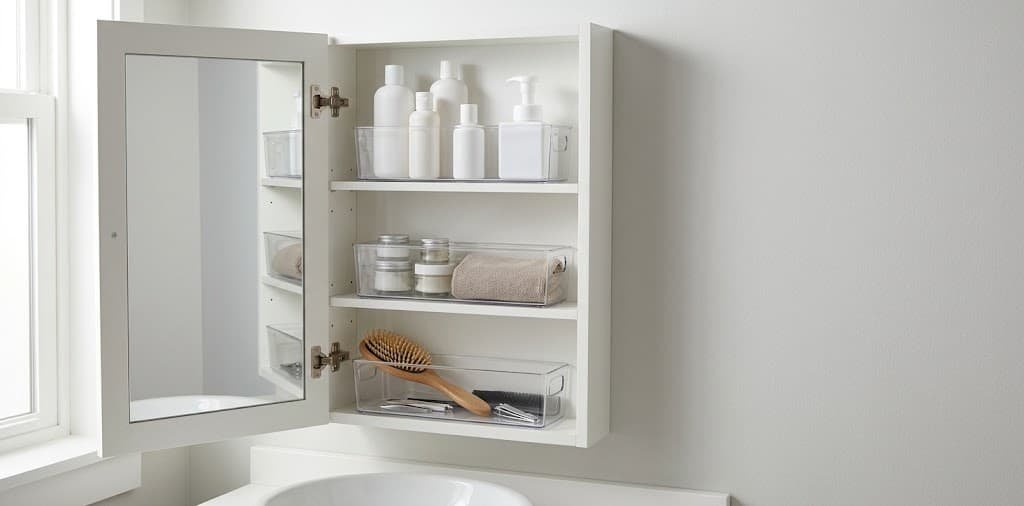
- Place the bins or trays on each shelf before returning items, then load each group into its designated bin. The bin does double duty — it keeps the group physically contained, and it means the whole group can be pulled out together if you ever need to travel with it.
- Move any medications to their separate lockable box or high shelf now, physically apart from the daily-routine sequence, rather than leaving them at the point where they got sorted during step one.
- Do a dry run tomorrow morning specifically to notice where your hand goes first, and adjust one shelf if the sequence does not quite match your actual motion. The plan on paper and your body’s actual habit are usually close but rarely perfectly identical on the first try.
The One Thing That Actually Makes This Work
Matching the shelf order to your actual physical sequence, not to a general logical grouping, is what determines whether this saves real time every morning or just looks tidy for a week.
A cabinet organized by product logic — skincare on one shelf, hair products on another — is internally consistent but ignores that your body moves in a specific physical order every morning regardless of how the products are categorized. If cleansing happens at the sink and styling happens in front of the mirror, and your cabinet puts styling products on the shelf nearest the sink, you are adding a physical detour to your routine every single day even though the cabinet looks perfectly organized.
The dry run in step six exists specifically to catch this gap, because the difference between a cabinet that looks logical and one that actually matches your body’s motion is only visible once you are moving through the real routine rather than planning it in the abstract.
Practical Tips
Store the items you use every single day at the most accessible height — roughly eye to chest level — and reserve the top and bottom shelves for weekly or occasional items, since those positions require the most effort to reach regardless of how the rest of the cabinet is arranged.
Keep a small separate bin for travel-size versions of your daily products, pre-packed and ready, so a trip does not require raiding the main sequence and disrupting the system you just built.
Label the bins facing outward if more than one person shares the cabinet, even with something as simple as a strip of tape — a shared cabinet without labels drifts back toward mixed piles within weeks in most households, since nobody feels individually responsible for maintaining an unlabeled shared space.
Mistakes to Watch Out For
Storing medications in the main sequence rather than a separate, more controlled spot is the most consequential mistake, particularly in a household with children — a cabinet organized for easy morning access is, by the same design, organized for easy access generally, which is exactly the opposite of what medication storage should prioritize.
Sorting by product category out of habit, even while attempting this system, is the second common mistake — it is the default most people fall back into without noticing, since it feels more “organized” in the moment even though it works against the actual goal of matching your physical routine. Catching yourself grouping by category mid-sort and consciously redirecting to routine order is worth the extra attention it takes.
Skipping the expiration check because everything is already out and the temptation is to just put it all back quickly is the third — this is the one moment in the whole process where checking costs nearly nothing extra, and skipping it means expired products sit in the newly organized cabinet for months until the next full reorganization.
Budget Breakdown
Budget tier: Repurposed containers you already own — a small box, a mug, a shallow dish — used as the shelf bins, with medications simply moved to a high shelf out of easy reach. This costs nothing and captures the core sequence-matching benefit entirely.
Mid-range tier: Purpose-sized clear bins matched to your specific shelf dimensions, plus a small lockable box for medications if the cabinet is shared with children. Clear bins add the benefit of seeing contents without opening each one, which matters more in a fast morning routine than it sounds.
Higher-investment tier: Pull-out shelf inserts or a tiered riser system for cabinets with awkward depth, where items at the back become genuinely hard to see or reach without something to bring them forward — worth it specifically for a deep cabinet where the sequence system alone cannot fully solve the reach problem.
Adjusting It for Your Bathroom
In a small cabinet with only one or two shelves, compress the sequence into fewer physical zones rather than trying to force five distinct shelf levels into a space that only has two — group cleansing and treatment together on the top shelf, styling and everything else on the bottom, and rely on the bins within each shelf to maintain the internal order.
In a shared cabinet with genuinely different morning routines between people, split the cabinet by person rather than by routine step — a left-side and right-side division, each person’s own sequence contained within their half — since two different sequences competing for the same shelf order defeats the purpose entirely.
In a cabinet also used for occasional guest supplies, keep those items in a single separate bin at the very back or bottom, outside the daily sequence entirely, so they never compete with the shelves your actual routine depends on.
Keeping It Organized
Do a two-minute check monthly, specifically for anything that has drifted out of its assigned bin, since a cabinet used daily under time pressure will slowly develop small misplacements even with a good system in place.
Recheck expiration dates every few months rather than only during a full reorganization, since skincare and medication expiration is easy to lose track of once products are neatly contained and out of sight.
Where to Start
The honest case for this system is specific: a cabinet arranged to match your actual morning sequence removes the small physical detours that a category-organized cabinet adds every single day, and that adds up to real time saved specifically during the part of the day when time is tightest.
Empty the cabinet this weekend, sort by routine step rather than product type, and run through tomorrow’s morning paying attention to where your hand actually goes. That dry run is what turns a tidy-looking cabinet into one that genuinely works.