


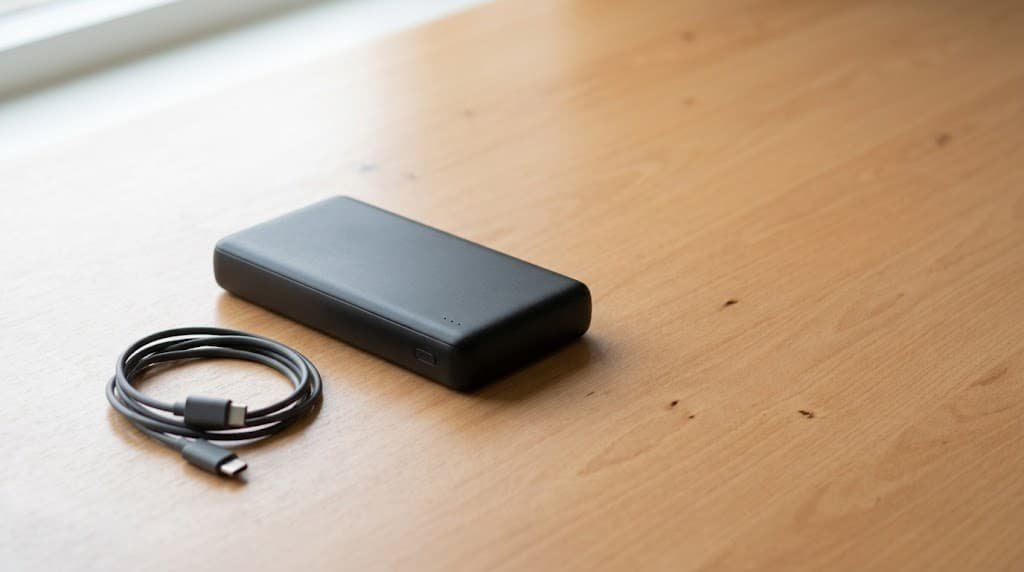
The mAh number on a portable charger’s box is not a lie, exactly, but it is not the number that matters either. A charger rated at 10,000mAh will never actually deliver 10,000mAh to your phone — physics and basic electronics guarantee a meaningful loss along the way, and the gap between the advertised figure and the usable one is the single most misunderstood spec in this entire category.
This guide is built around that gap, plus the two other factors — output wattage and cycle life — that actually determine whether a portable charger is still useful in two years or dead in the back of a drawer. It is based on public specifications and how battery chemistry and voltage conversion work, not a hands-on test of specific models, since exact real-world capacity varies by unit and by how a charger has been used. The goal is a framework for reading any portable charger’s spec sheet correctly, since the specific models on shelves change constantly while the underlying physics governing capacity and output does not.
Who This Is Actually For
This is for backup power for phones, tablets, and small devices during travel, commuting, or a day away from an outlet — the situation most people actually buy a portable charger for. It covers laptop charging separately in Section 4, since that use case has different requirements that most basic chargers do not meet.
If you need to charge a laptop specifically, skip ahead to the USB-C Power Delivery discussion in Section 4 before anything else — a standard phone-focused charger will not charge most laptops at all, regardless of its capacity rating, since laptops require both a higher output wattage and the correct charging protocol that basic chargers simply do not include.
What Matters Most Here
Three numbers actually determine whether a portable charger serves you well: real usable capacity, output wattage, and cycle life. The advertised mAh figure on the box is the least useful of the three on its own, covered in full in Section 5.
Output wattage determines charging speed, and it matters more than most buyers expect — a charger with a high capacity but low output wattage will charge a phone slowly regardless of how much total power it holds, which defeats much of the point of carrying a backup charger in the first place. Cycle life is how many full charge-and-discharge cycles the internal battery can handle before its capacity degrades noticeably, and it is the number that determines whether a charger purchased today is still useful in two years. All three numbers are covered in detail in the sections that follow, but understanding that they are three separate, largely independent specifications is the first step to reading any product listing correctly.
How They Compare
Small chargers in the 5,000 to 10,000mAh range are pocket-sized and good for one to two phone charges, and they are the right category for daily commuting or as backup for a single device during a normal day out. Their small size also means they are the category most likely to actually get carried consistently, which matters more for real-world usefulness than raw capacity does.
Standard chargers in the 10,000 to 20,000mAh range add real weight and bulk but deliver two to four phone charges, making them better suited to travel or multi-day situations where reaching an outlet is not guaranteed.
High-capacity chargers above 20,000mAh, particularly those supporting USB-C Power Delivery at 30 watts or higher, can meaningfully charge a laptop rather than just topping off a phone — but they are significantly heavier, and airline carry-on regulations generally cap batteries at 100 watt-hours without airline approval, which most chargers in this range approach or exceed, so checking the watt-hour rating specifically matters if this charger will be flown with regularly.
The Deciding Factor
The gap between advertised mAh and real usable capacity, and understanding why it exists, changes how every other spec on the box should be read.
Portable charger batteries are internally rated at 3.7 volts, but USB output runs at 5 volts, which means the charger has to step the voltage up before it reaches your device — and that conversion process is not perfectly efficient. Combined with the internal circuitry’s own power draw, a charger advertised at 10,000mAh typically delivers closer to 6,000 to 6,500mAh of real, usable charge to a connected device — roughly 60 to 65 percent of the advertised figure, and this loss is consistent across the category rather than being specific to any one poorly made product.
This means the accurate way to estimate how many phone charges a portable charger will actually provide is to take the advertised mAh figure, multiply by roughly 0.6, and divide by your specific phone’s battery capacity — not to divide the advertised figure directly, which overstates real capacity by nearly half.
Other Details Worth Knowing
Cycle life for most current portable chargers using standard lithium-ion cells runs approximately 300 to 500 full cycles before capacity degrades to around 80 percent of original — which for a charger used a few times a week translates to roughly two to three years of daily-relevant use before the difference becomes noticeable in how many charges it delivers. Manufacturers that publish this figure explicitly, rather than omitting it from the spec sheet entirely, are generally more confident in the underlying cell quality, which is worth treating as a signal in itself.
Pass-through charging — the ability to charge the power bank itself while it simultaneously charges a connected device — is a genuinely useful feature that is not universal, and it is worth confirming specifically if you plan to charge the bank overnight while it is also topping off a phone, since not every model supports this without risk to the battery.
Watt-hour rating, calculated from the mAh figure and voltage, is what airline regulations actually reference rather than mAh directly — most airlines allow up to 100 watt-hours in carry-on without special approval, batteries between 100 and 160 watt-hours generally require airline approval, and anything above 160 watt-hours is typically prohibited outright, which is worth checking before a high-capacity charger gets purchased specifically for travel.
Common Regrets and Mistakes Buyers Make
Buying based on mAh alone without checking output wattage is the most frequent mistake — a high-capacity charger with low output wattage charges slowly enough that it can feel like it is barely working, even though it genuinely holds a large amount of power, because the bottleneck is delivery speed rather than total capacity.
Ignoring cycle life and buying the cheapest available option in a given capacity range is the second common regret — the cells and circuitry that support a longer cycle life add real manufacturing cost, and a charger that seems like equivalent value at purchase based on mAh and price alone frequently degrades to noticeably reduced capacity within a year, well before a better-built equivalent would.
Buying a high-capacity charger for occasional laptop charging without checking Power Delivery wattage specifically is the third — many chargers marketed with laptop-capable capacity still only output 18 to 20 watts, which is enough for a phone but insufficient to charge most laptops at a meaningful rate, and the mAh figure alone gives no indication of this limitation.
If Your Needs Are Different
If frequent air travel is the primary use, prioritize a charger explicitly rated under 100 watt-hours over one with maximum capacity — the convenience of avoiding airline approval requirements at security outweighs the benefit of extra capacity for most travelers, and a charger that gets confiscated or delayed at a checkpoint provides zero value regardless of its rating.
If laptop charging is a regular need rather than an occasional one, prioritize confirmed USB-C Power Delivery output of at least 45 watts specifically, and treat total mAh capacity as secondary — a charger with lower capacity but genuinely sufficient output wattage will charge a laptop meaningfully faster than a higher-capacity charger with insufficient wattage.
If daily carry weight matters more than total capacity — genuinely carried every day rather than packed for occasional trips — a smaller charger in the 5,000 to 10,000mAh range that actually gets carried consistently provides more real-world value than a larger one that stays home because of its weight.
Is It Worth the Price
Within the same capacity tier, the price difference between a basic charger and a better-built one is usually justified specifically by cycle life and build quality of the internal circuitry — components that are invisible on a spec sheet but directly determine whether the charger still performs adequately in year two rather than year one.
Paying more purely for a higher mAh number without confirming adequate output wattage and reasonable cycle life data is not a reliable way to get better value — a mid-capacity charger from a manufacturer that publishes cycle life data honestly is frequently a better long-term purchase than a higher-capacity charger from one that does not.
Getting the Most Out of It
Avoid letting a portable charger sit fully depleted for extended periods, and avoid leaving it at 100 percent charge in hot conditions like a parked car — both extremes accelerate the capacity degradation described in Section 6 meaningfully faster than moderate, regular use does.
Use the highest-wattage cable and port combination the charger supports specifically, since an underpowered cable can bottleneck charging speed even when the charger itself is capable of faster output — this is an easy detail to overlook since the charger gets blamed for slow charging that is actually a cable limitation.
Charge the power bank itself to around 80 percent rather than always topping off to 100 for daily use, if the model allows setting this, since consistently charging to 100 percent is one of the more significant accelerators of long-term capacity loss in lithium-ion batteries generally.
Closing Note
The honest number to look for is not the mAh figure on the box, but that figure multiplied by roughly 0.6, paired with an output wattage that actually matches what you intend to charge. Those two numbers, checked together, predict real-world usefulness far better than capacity alone.
Before buying, calculate the real usable capacity using the 0.6 multiplier from Section 5, and confirm the output wattage matches your primary device. Those two checks account for most of what separates a charger that still works well in two years from one that quietly becomes useless.