


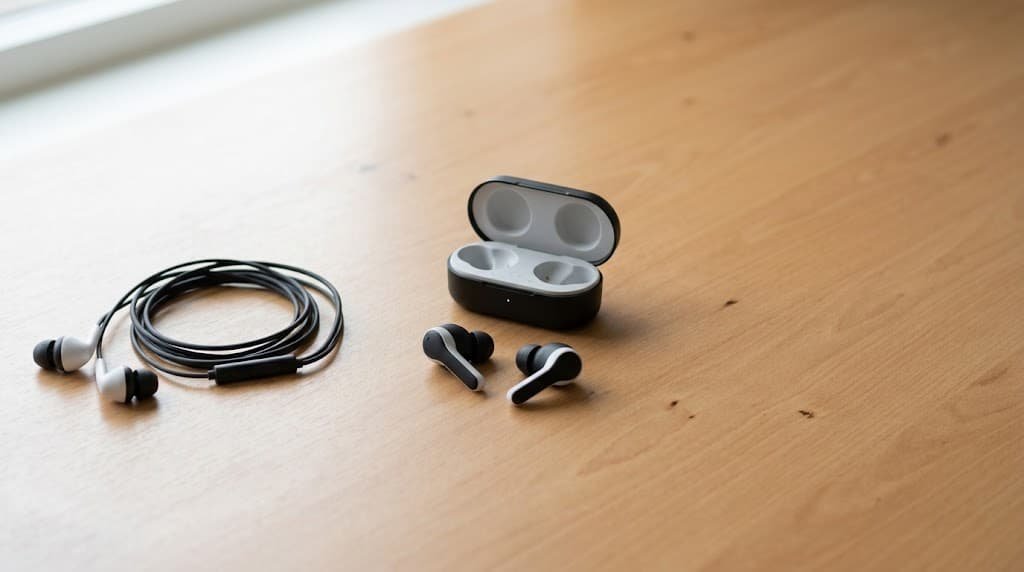
The wired versus wireless question gets treated as a settled debate — wireless won, wired is obsolete — when the actual answer depends entirely on one variable most comparisons skip: whether latency matters for what you are doing. For music and podcasts, it does not. For anything involving watching video, gaming, or precise timing, it does, and Bluetooth’s fundamental design introduces a delay that no amount of premium pricing fully eliminates.
This comparison is built on the physical differences between the two connection types and how those differences show up in ordinary daily use — not a hands-on test of specific models, since exact latency and battery figures vary by chipset generation even within the same brand’s product line. The goal is a framework for deciding which category fits your actual use, since that decision matters more than any individual model within either one.
Who This Is Actually For
This comparison is for anyone deciding between the two connection types for daily use — commuting, working out, working at a desk, or watching video — rather than choosing a specific model within either category. If you have already decided on wireless and need a specific recommendation, a dedicated buying guide comparing individual wireless models will serve you better than this comparison of the two categories themselves.
If your use is exclusively music or podcasts with no video or gaming involved, the connection type genuinely matters less than sound quality and fit, both of which vary more within each category than between them. For that specific use, the choice comes down to convenience preferences rather than any technical limitation covered in this comparison.
What Matters Most Here
Three things actually separate the two categories in daily use: latency, battery dependency, and physical reliability. Sound quality is not on this list deliberately — at any given price point, wired and wireless earbuds using comparable driver technology sound close enough that connection type is not the deciding factor for audio quality.
Latency is the delay between when audio is sent and when it reaches your ears. Wired earbuds carry an electrical signal directly, with latency close enough to zero to be imperceptible. Wireless earbuds using Bluetooth compress the audio, transmit it wirelessly, then decompress it on the earbud itself — a process that reliably adds somewhere between 100 and 300 milliseconds depending on the specific Bluetooth codec in use, and that delay is large enough to notice as a lip-sync mismatch on video or a lag between action and sound in games. Battery dependency and physical reliability, the other two factors on this list, are covered in detail in the sections that follow, since each affects a different part of daily use.
How They Compare
Wired earbuds have no battery to manage, no pairing process, and no latency — plug in and the connection is immediate and total. Their tradeoff is the cable itself: it catches on doorknobs, gets tangled in pockets, and physically limits movement in a way wireless simply does not. The connector itself matters too — USB-C has become the standard on most current phones, and confirming your device uses that connector rather than an older one avoids an adapter becoming a permanent, easily lost accessory.
Wireless earbuds remove the cable entirely, which is the actual reason most people prefer them — freedom of movement during exercise, no cable to catch on anything, and no cable noise transmitted directly into the ear canal when it brushes against clothing. Their tradeoffs are the latency described above, a battery that needs regular charging and will eventually degrade with age, and a pairing connection that can drop or lag under interference from other wireless devices in a crowded environment.
A middle category worth knowing about: wireless earbuds with a physical cable connecting the two earpieces, sometimes called neckband style, which eliminates the risk of losing a single earpiece and typically offers meaningfully longer battery life than fully wireless earbuds, at the cost of some of the freedom that made wireless appealing in the first place. This middle option is worth considering specifically for anyone drawn to wireless for its battery life or loss-resistance rather than for the completely cable-free feel of fully wireless earbuds.
The Deciding Factor
If you regularly watch video or play games with earbuds, the latency difference described in Section 3 should decide this on its own, and it points toward wired — or toward wireless earbuds specifically supporting a low-latency codec, covered in the next section, rather than standard Bluetooth.
Standard Bluetooth audio latency is noticeable enough during video that dialogue and lip movement fall visibly out of sync, and during gaming, it is large enough to matter in anything requiring fast reaction timing. This is not a minor inconvenience that fades with familiarity — it is a fixed technical delay inherent to how standard Bluetooth audio works, and no earbud at any price eliminates it without using an alternative codec.
Other Details Worth Knowing
Low-latency Bluetooth codecs exist specifically to address the gap in Section 5 — designed for gaming and video use, and capable of cutting the delay to a range close to imperceptible. The tradeoff is that both the earbuds and the source device need to support the same codec for the benefit to apply, which is not universal across devices, so checking compatibility with your specific phone or console before buying is essential if latency is the deciding factor.
Battery degradation is a wireless-specific cost that is easy to overlook at purchase. The small batteries in wireless earbuds lose charge capacity over roughly one to two years of regular daily use, and unlike a phone battery, this is generally not something that can be replaced — a wireless earbud with meaningfully reduced battery life is typically at the end of its usable life, while a wired earbud with a working driver keeps functioning indefinitely. This is worth factoring into any price comparison between the two categories, since a wired pair’s cost is effectively spread over a much longer usable lifespan.
Earbud loss risk is asymmetric between the two categories. Losing one fully wireless earbud effectively breaks the pair, while a wired pair connected by a cable, or a neckband-style wireless pair, cannot be separated and lost individually the same way.
Common Regrets and Mistakes Buyers Make
Buying wireless for gaming or frequent video calls without checking for low-latency codec support is the most common mistake in this category, and it typically shows up as a vague, hard-to-diagnose sense that audio feels “off” during calls or games rather than an obvious problem — because the cause is a consistent, low-level delay rather than a dramatic failure.
Assuming wireless sound quality automatically matches wired at the same price point is the second common mistake — Bluetooth audio compression, even with a good codec, introduces some quality loss compared to a direct wired connection, and while it is genuinely difficult to hear in casual listening, it is measurable and occasionally audible on complex, detail-heavy recordings.
Underestimating how often a charging routine gets skipped is the third — wireless earbuds left uncharged overnight are unusable the next morning in a way a wired pair, which needs no charge at all, simply is not, and this is a bigger practical issue for many buyers than either latency or sound quality. A charging case that also holds a meaningful reserve charge reduces this risk somewhat, but does not eliminate it the way having no battery at all does.
If Your Needs Are Different
If exercise and movement are the primary use, wireless is worth the latency and battery tradeoffs for nearly everyone — the freedom from a cable during physical activity outweighs the downsides described above for this specific use case, and this is the scenario wireless earbuds were fundamentally designed to solve. A secure, sweat-resistant fit matters more than latency or even battery life for this specific use, and it is worth prioritizing over both when comparing options within the wireless category.
If cost matters more than convenience, wired remains meaningfully cheaper for comparable sound quality, since wireless earbuds carry the added cost of a battery, charging case, and wireless chipset that wired earbuds simply do not need to include.
If reliability in professional settings matters — calls where audio dropping out mid-sentence is a real problem — wired removes an entire category of failure that wireless cannot fully eliminate, since any wireless connection carries some risk of interference or dropout regardless of price tier.
Is It Worth the Price
Wireless earbuds at a genuinely low price point commonly cut corners specifically on the battery and the wireless chipset — the two components governing latency, connection stability, and how long the earbuds remain usable before degrading — since these are the least visible corners to cut in initial marketing copy and the most expensive to do well. A low price tag says little on its own about which corners were cut, which is why checking the specific battery and chipset specifications matters more than the price alone.
For most casual listening use, a mid-tier wireless option balances these tradeoffs reasonably; for latency-sensitive use like gaming or frequent video calls, spending more specifically to get verified low-latency codec support matters more than spending more for other features like noise cancellation or extended battery life. Paying extra for noise cancellation while ignoring codec support solves a different problem than the one that actually affects video and gaming use.
Getting the Most Out of It
For wireless earbuds, check your specific phone or console’s Bluetooth codec support before purchase rather than after — codec compatibility is listed in device specifications and is worth five minutes of research before spending money on a low-latency pair that will not actually pair with a low-latency codec on an unsupported device.
For wired earbuds, a cable with an inline remote and microphone adds negligible cost and meaningfully improves daily usability for calls and media control, and it is worth confirming this feature specifically rather than assuming all wired earbuds include it.
For either type, replacing worn silicone ear tips periodically — a low-cost accessory available for most models — meaningfully improves both comfort and sound isolation as the originals wear down, and this single maintenance habit is skipped by most owners despite being one of the cheapest ways to extend usable life.
Closing Note
The honest takeaway is narrower than the marketing framing suggests: this is not wireless winning a settled competition, it is a genuine tradeoff between zero latency and cable freedom, and the correct choice depends entirely on whether your specific use — video, gaming, exercise, calls — falls on the latency-sensitive or freedom-sensitive side of that line.
Before buying either type, identify honestly whether video or gaming is a regular part of your use. That single answer determines which side of this comparison actually applies to you, more than any other factor covered above, including price and brand.