

Walk into two apartments with nearly identical square footage, furnished with roughly the same amount of stuff, and one will feel genuinely spacious while the other feels like it is closing in. The difference rarely comes down to how much furniture is in the room. It comes down to how much floor you can actually see underneath it.
This is a guide built around that specific principle — furniture choices for a small space that prioritize visible floor and open sightlines over simply buying smaller versions of everything, since smaller furniture is not actually the thing that makes a room feel bigger. What follows is a way of shopping and arranging that applies regardless of your room’s specific dimensions or style.
Why Visible Floor Matters More Than Furniture Size
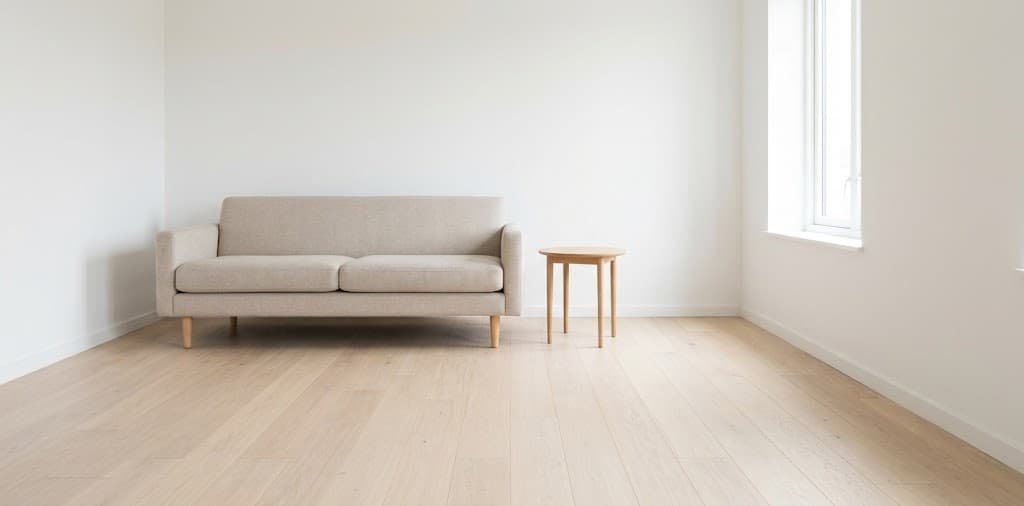
The eye reads a room’s size largely by how much uninterrupted floor and wall it can see, not by measuring the actual square footage. A sofa with a solid skirt running to the floor blocks that sightline completely along its entire length, and the room reads as ending at the sofa’s edge. The same sofa on visible legs, with several inches of floor showing underneath, lets the eye travel past it to the wall behind, and the room reads as continuing well past where the furniture actually sits.
This is why a single well-proportioned piece on visible legs often makes a small room feel larger than the same room filled with several smaller pieces that each touch the floor along their whole base — the total floor area consumed can be nearly identical, but the perceived openness is not, because perceived openness tracks visible floor, not furniture footprint. This is a genuinely counterintuitive point for most people shopping for a small space, since the natural instinct is to shrink everything rather than to reconsider what each piece rests on.
What to Look For When Shopping
- Exposed, tapered legs rather than a solid skirt or a boxy base that runs to the floor — this single feature does more to make a piece feel light in a small room than its actual dimensions do.
- A tape measure and the room’s actual dimensions, written down before shopping, since it is far too easy to fall for a piece that looks reasonably sized in a large showroom and turns out to dominate a small room at home.
- Multi-functional pieces where genuinely useful — a storage ottoman, a drop-leaf or extendable table — though only where the dual function is something you will actually use, covered further in the mistakes section.
- A consistent, limited color palette across major pieces, since visual busyness from too many competing tones reads as clutter regardless of actual furniture size.
How to Furnish a Small Space, Step by Step
- Measure the room and mark out furniture footprints on the floor with painter’s tape before buying anything, using the actual dimensions of pieces you are considering. This single step catches oversized purchases before they happen, rather than after delivery.
- Choose one substantial anchor piece rather than several smaller ones filling the same role. One well-proportioned sofa on visible legs reads as more spacious than a sectional and a separate armchair occupying similar total floor area, because the single piece leaves more continuous visible floor around it.
- Prioritize exposed-leg furniture for every major piece — sofa, chairs, media console — rather than just one. The visible-floor effect compounds across a room; one piece with exposed legs surrounded by skirted, floor-touching pieces still reads as cramped overall.
- Position furniture away from walls by a few inches rather than pushed flush against them, where the room allows it. Counterintuitively, floating a piece slightly off the wall often reads as more spacious than pushing everything to the perimeter, since it creates a visible shadow line that adds depth.
- Add multi-functional pieces only where you have identified a genuine, specific dual need — not simply because a piece is marketed as space-saving. A storage ottoman used only as a footrest and never opened is not actually solving a storage problem; it is just an ottoman with hidden clutter inside.
- Step back and evaluate sightlines from the room’s main entry point once furniture is placed, since this is the view that determines a visitor’s first impression of the room’s size, and it is worth checking specifically rather than only evaluating the room from inside it.
The Detail That Actually Makes the Difference
Consistent leg height and visible negative space beneath every major piece in the room, not just one, is what separates a small space that reads as airy from one that reads as cramped despite careful furniture choices.
A single piece on tall, visible legs surrounded by low, skirted furniture creates visual inconsistency that draws attention to the mismatch rather than smoothing it over — the eye notices the one piece that lets floor show through and the rest that does not, and that inconsistency itself reads as cluttered even though no individual piece is oversized. The effect only fully works when applied consistently across the room’s major furniture, not as an exception on a single statement piece.
This is also why matching leg heights across different pieces, even from different manufacturers, is worth checking specifically before purchase — a coffee table with four-inch legs next to a sofa with eight-inch legs breaks the continuous sightline the whole strategy depends on, even though each piece individually looks fine.
Practical Notes
Light-colored or reflective furniture surfaces bounce more available light around a small room than dark, matte ones, and this compounds with the visible-floor effect rather than replacing it — the two strategies work best combined rather than as alternatives to each other.
Vertical storage — tall, narrow bookshelves rather than wide, low ones — uses wall space that a small room usually has in excess while preserving the floor space that a small room usually lacks, which is the opposite tradeoff a wide, low dresser or credenza makes.
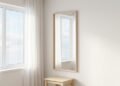
A large-scale piece of art or a single oversized mirror often works better in a small room than several smaller pieces scattered across a wall, since one large focal point reads as intentional while several small ones read as visual clutter competing for attention.
Common Mistakes to Avoid
Buying uniformly smaller furniture across the board is the most common mistake — undersized pieces in a room built for standard proportions often look more cramped than well-proportioned pieces would, since the mismatch between furniture scale and room scale reads as awkward rather than spacious.
Choosing multi-functional furniture purely for the label rather than a genuine need is the second common mistake — a sofa bed nobody ever unfolds or a nesting table set that never actually gets separated adds cost and sometimes bulk without delivering the flexibility it was chosen for.
Pushing every piece flush against every wall out of an instinct to “maximize the center,” is the third — this often creates a room that feels like a waiting area, with a large, dead central void rather than a room that feels used and comfortable, and a few pieces floated slightly off the walls, as covered in step four, generally reads as more intentional and more spacious.
Where to Invest
At the budget tier, prioritize the exposed-leg principle above all else even on modestly priced pieces — this single detail is available across a wide range of price points and delivers most of the visible benefit regardless of what else the budget allows.
At the mid-range tier, genuinely well-designed multi-functional pieces — a coffee table with a lifting top for dining or working, a bed frame with real built-in storage — start becoming worth the added cost, since better design at this tier delivers dual function without the bulk that cheaper multi-functional furniture often carries.
At the higher-investment tier, custom or made-to-measure furniture sized precisely to an awkward or unusually proportioned small room solves fit problems that off-the-shelf furniture, however well chosen, sometimes cannot — worth it specifically for a genuinely irregular room where standard dimensions consistently leave wasted space or crowd a walkway.
Adjusting for Your Specific Space
In a studio apartment where furniture has to define separate zones without walls, use area rugs to visually anchor each zone rather than relying on furniture placement alone, since furniture alone in an open studio can read as one undifferentiated cluttered space regardless of how well each individual piece is chosen.
In a small room with low ceilings specifically, prioritize furniture with visible legs even more heavily than in a small room with standard ceiling height, since the visible-floor effect does more compensating work when vertical space is also constrained.
In a small room used by multiple people for different activities — a combined living and home office, for instance — genuine multi-functional furniture earns its keep here specifically, since the dual-use need is real and ongoing rather than a marketed feature with no actual application in your daily routine.
Keeping It Feeling Open
Reassess what has accumulated on and around furniture every few months, since visible floor space erodes gradually as small items pile onto surfaces and beneath furniture over time, quietly undoing the openness the furniture choices were meant to create.
Resist adding “just one more” small piece to fill an apparently empty corner, since an intentionally empty corner is doing real visual work for the room, and filling every available gap is precisely the instinct that makes a small space feel cramped despite thoughtfully chosen furniture.
Where to Start
The honest case here is narrow and specific: visible floor beneath furniture, not smaller furniture, is what makes a small room read as spacious — and that single principle, applied consistently, does more work than any individual piece or product marketed specifically for small spaces.
Before buying anything, check whether it stands on visible legs or runs to the floor along a solid base. That one check, applied to every major piece in the room, predicts how the finished room will actually feel more reliably than its listed dimensions do.