


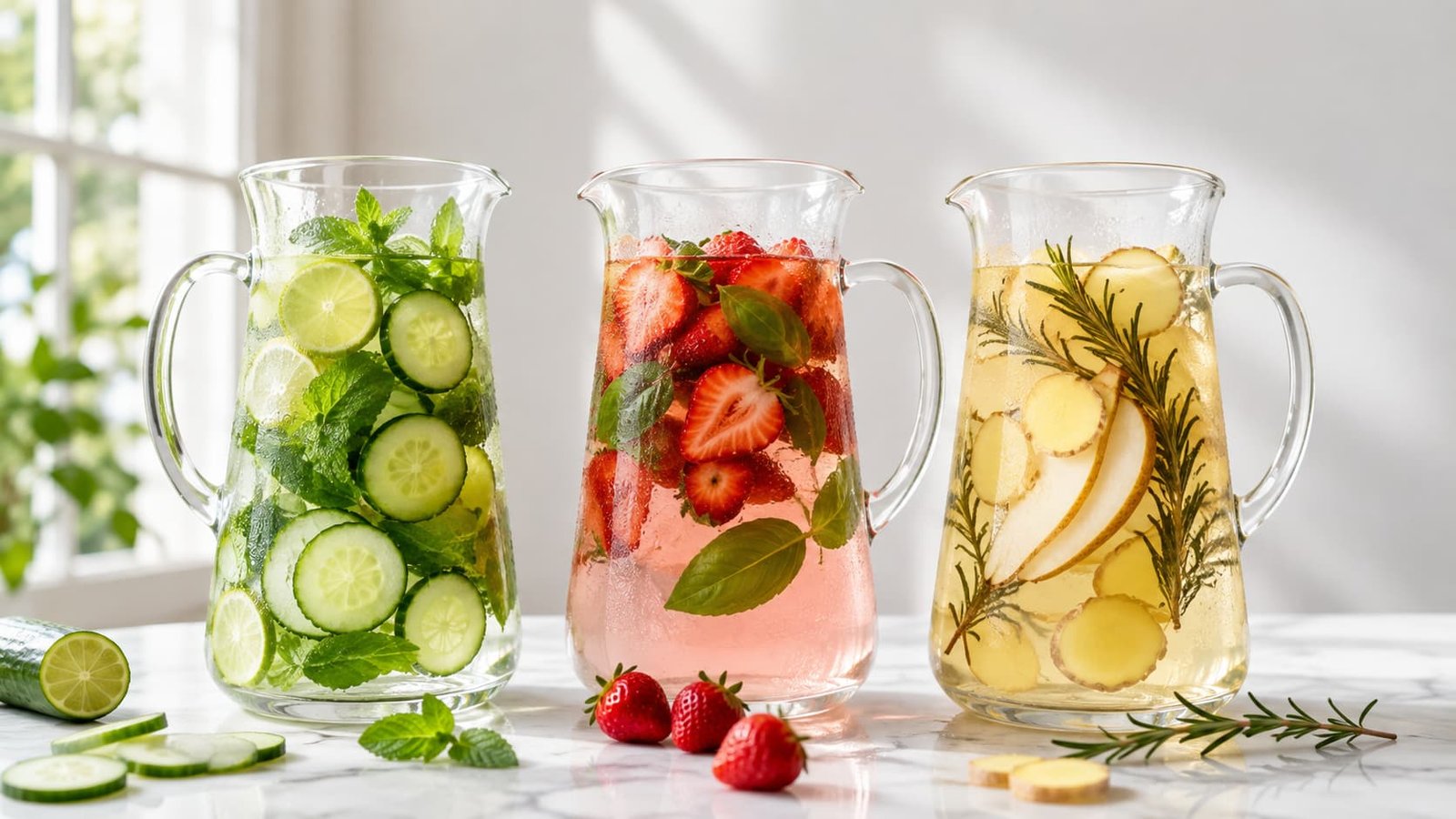
Infused water belongs to the same technique family as cold brew coffee and cold-steeped tea: extraction by diffusion, without heat. Nothing cooks, nothing emulsifies, and there is no reaction to manage. What there is instead is a timing problem, and it is a more interesting one than most recipes admit.
Every fruit, herb, and root releases its soluble compounds at a different rate, governed by cell wall structure and surface area. Cucumber gives up everything within two hours; ginger needs eight; citrus peel releases pleasant aromatics for a few hours and bitter compounds after that. Put all three in one pitcher overnight — which is what almost every article on the subject tells you to do — and you get bitter water with soft grey fruit in it.
The three combinations below are built around that principle — each one groups ingredients that extract on a similar schedule, so everything peaks at the same moment.
| Active Time | Infusion Time | Makes | Keeps |
|---|---|---|---|
| 8 minutes | 2–12 hours | 2 liters each | 3 days |
The Technique Behind It
Infusion is diffusion: dissolved compounds move from high concentration inside plant tissue to low concentration in the surrounding water until the two approach equilibrium. The rate depends on surface area, temperature, and time.
What matters more is what cold water can and cannot dissolve. Water is polar, so it readily extracts sugars, organic acids, and the water-soluble pigments called anthocyanins. It does poorly with the essential oils carrying most of a fruit’s aroma, because those are lipophilic — fat-soluble, not water-soluble. This is why infused water always tastes delicate rather than like diluted juice, and no technique changes it. Anyone expecting fruit-punch intensity from water and fruit alone will be disappointed, and saying so is more useful than promising otherwise.
The second governing fact is that not everything extracted is desirable. Citrus pith — the white layer under the peel — holds limonin and naringin, both intensely bitter and water-soluble. They diffuse more slowly than the aromatics in the outer zest, which creates a window: peel-on citrus tastes bright for three hours and turns progressively bitter after four. Refrigeration at 40°F roughly halves the diffusion rate versus room temperature, so every timing below assumes a cold fridge.
The Three Combinations
Each makes 2 liters. Use filtered water — chlorine contributes a chemical note that competes with delicate aromatics, and in a preparation this subtle it is immediately noticeable.
Fast infusion, 2 to 3 hours: Cucumber, Mint, and Lime
- 1 medium English cucumber, sliced into ⅛-inch rounds — English rather than standard field cucumber: thinner skin, fewer seeds, and no wax coating to block diffusion. At 96 percent water content and sliced thin, it releases its full flavor within 2 hours. It also collapses fastest, which sets the schedule for the whole combination.
- 20 mint leaves, left whole — Menthol sits in glandular trichomes on the leaf surface, so it releases with almost no encouragement.
- 1 lime, peeled and sliced — Peel it. Removing the pith eliminates the bitterness clock entirely and lets you extend the infusion without penalty.
- 2 liters filtered water and a scant pinch of fine salt (about 1/16 teaspoon)
Medium infusion, 4 to 6 hours: Strawberry, Basil, and Black Pepper
- 10 ounces strawberries, hulled and halved — The waxy cuticle on a berry is a diffusion barrier, so halving is not optional; whole berries release almost nothing in six hours. Their anthocyanins are pH-sensitive, which is why this runs pink rather than red — water near pH 7 pushes the color blue-violet, and it turns visibly redder with lime.
- 12 basil leaves, gently slapped between your palms — Slapped, not torn.
- 6 black peppercorns, lightly cracked — Piperine is only partially water-soluble, so it contributes a faint warmth at the finish rather than heat. It sharpens the strawberry noticeably and is the element that makes this taste composed rather than accidental.
- 2 liters filtered water and a scant pinch of fine salt
Slow infusion, 8 to 12 hours: Ginger, Pear, and Rosemary
- 2-inch piece fresh ginger, peeled and sliced into thin coins — Ginger’s gingerols sit inside dense, fibrous tissue with low surface-to-volume ratio, which is why it needs 8 hours minimum where cucumber needs 2.
- 1 firm Bosc pear, cored and thinly sliced — Bosc specifically. Its flesh is dense and low in the pectin-degrading enzymes that make Bartlett pears go mushy and cloud the water within a few hours.
- 2 rosemary sprigs — Rosemary’s aromatics are held in woody, resinous tissue and release slowly, which puts it on the same schedule as the ginger. Rosemary in a 2-hour infusion contributes almost nothing.
- 2 liters filtered water and a scant pinch of fine salt
On the salt: a pinch below the detection threshold does two measurable things — sodium ions suppress bitterness perception and raise perceived sweetness. At 1/16 teaspoon per 2 liters the water does not taste salty, it tastes rounder and less thin. Highest-return addition in the recipe.
Substitutions and their consequences: frozen berries extract faster, since ice crystals rupture cell walls — but they cloud the water and disintegrate within 4 hours. Bottled lime juice gives acid without aromatics, defeating the purpose. Dried herbs are the one swap I would refuse: the volatiles are largely gone and what remains reads dusty in cold water.
Method
- Wash everything under cold running water and dry it. Surface residue and bacteria go in with the fruit and stay for three days — and nothing here reaches a temperature that kills anything.
- Cut to maximize surface area without destroying structure. Cucumber at ⅛ inch, strawberries halved, pear at ⅛ inch, ginger in coins about ⅛ inch thick. Thinner is faster but collapses sooner — these thicknesses hold their shape for the full infusion window.
- Handle the herbs correctly. Press the leaves flat between your palms and clap once. That single impact ruptures the surface oil glands without breaking the leaf’s internal cell walls. Do not muddle or bruise herbs with a spoon. Crushing the leaf tissue releases chlorophyll and the enzymes that degrade it, and the result is a grassy, faintly bitter flavor and a green tinge in the water — the most common technical error in this preparation, and it is irreversible.
- Add the solids to the pitcher first, then pour the water over them. Pouring water onto the fruit rather than dropping fruit into water gives you initial agitation, which starts the concentration gradient moving. Stir once.
- Add the salt and stir until dissolved, about 15 seconds. Now rather than at serving — sodium has to be evenly distributed through the volume to suppress bitterness.
- Cover and refrigerate at 40°F for the interval that matches the combination: 2 to 3 hours for cucumber-mint-lime, 4 to 6 for strawberry-basil-pepper, 8 to 12 for ginger-pear-rosemary. Cover it — an uncovered pitcher absorbs refrigerator odors, and a preparation this subtle picks up the smell of last night’s onions readily.
- Taste at the low end of the window, then every 30 minutes. The correct endpoint is when the flavor is clearly present but the water still tastes like water. Past that point you are not gaining intensity — the extraction has largely equilibrated and what continues is textural breakdown.
- Strain out all solids when it hits the window. This is the step almost every recipe omits, and it is the difference between a pitcher that is good for three days and one that is good for six hours. Leaving fruit in the water means cell walls continue breaking down, releasing pectin and starch that cloud the water and eventually turn it sour.
- Serve over ice, and add the ice to the glass, not the pitcher. Ice in the pitcher dilutes the infusion as it melts, and by the second glass the water tastes noticeably weaker than the first.
Mastering the Extraction Window
Everything technical about this recipe reduces to one skill: knowing when to strain. It is learnable in two or three attempts, and it is worth developing because it applies to every cold infusion you will ever make.
Extraction follows a curve, not a line. Roughly 70 percent of the soluble compounds transfer in the first third of the window, then the rate slows sharply as the gradient flattens. By the end of the interval you are near equilibrium and gaining very little, and everything after that is downside: cell wall breakdown, pectin release, cloudiness, and in citrus, bitterness.
What success tastes like: the water should read clean on the front of the palate and carry the fruit on the finish. If the flavor hits immediately and heavily, you have gone past the point — that intensity is usually broken-down fruit tissue rather than clean extraction.
What to look at: clarity. Fully transparent with a faint tint is the right stage. Slight haze means suspended solids from collapsing cell walls, and haze always arrives before the taste goes off — a useful early warning.
The instinct to build is trusting the taste over the clock. A fridge at 44°F extracts noticeably faster than one at 37°F, and an August strawberry gives up more than a February one. The intervals are starting points; tasting is what makes them accurate.
Troubleshooting
Bitter, drying finish. Cause: citrus infused with the pith on for more than about four hours, releasing limonin and naringin. Not correctable once extracted. Peel all citrus, or cap peel-on infusions at three hours.
Grassy, vegetal flavor with a green cast to the water. Cause: herbs were muddled or torn, rupturing internal cells and releasing chlorophyll. Correction: strain immediately and dilute with fresh water by about a third; this reduces the intensity without fixing it. Prevention: the single palm clap in step 3.
The water tastes like almost nothing. Cause: a mismatch between ingredient and time — whole strawberries, unpeeled hard fruit, or rosemary in a two-hour infusion. Correction: extend the time and add surface area by cutting the fruit smaller. This is the one failure that is fully recoverable.
Cloudy water within a few hours. Cause: overripe or frozen fruit with already-compromised cell walls releasing pectin immediately. Straining through fine mesh removes suspended solids but not dissolved pectin — use firm, slightly underripe fruit instead.
Slimy cucumber slices and a dull flavor. Cause: the infusion ran past 6 hours. Cucumber at 96 percent water has almost no structural integrity to lose before it collapses. Strain at 3 hours and the problem never appears.
A faintly fermented, sour smell on day two. Cause: solids left in the water, providing sugar and surface for microbial growth at refrigerator temperature. Discard it. Straining on schedule prevents this reliably.
Variations Grounded in the Method
Add a mild acid to control color and brightness. Two tablespoons of lemon juice per 2 liters drops the pH enough to shift anthocyanins toward red — the strawberry version goes from dull pink to genuinely red — and the acid sharpens all the aromatics. This is the most technically useful addition available here.
Muddle nothing, but crush hard spices. Cracked cardamom pods, a split vanilla bean, or lightly cracked coriander seeds work in the slow infusion because their aromatics sit in dense tissue that needs mechanical breach. The same logic that forbids crushing mint requires crushing spices.
Use sparkling water, added at the end. Infuse in still water, strain, then combine 1:1 with cold sparkling water in the glass. Carbonation cannot survive an 8-hour open infusion, and dissolved CO2 also lowers the pH slightly, which brightens the fruit. Never infuse directly in sparkling water — you lose the carbonation and gain nothing.
Cold-steep a tea alongside the fruit. Add 2 green tea bags to the fast infusion for its final hour only. Cold water extracts the tea’s amino acids and sugars while leaving most of the astringent tannins behind, because catechins require heat to extract efficiently. The result is rounder than any hot-brewed iced tea.
Serving and Pairing
These are palate cleansers, not beverages that compete with food, and the pairing logic follows from that — they reset between bites through cold and mild acidity rather than flavor intensity.
The cucumber-mint-lime version belongs next to anything rich or fried. Menthol activates the mouth’s cold-sensing receptors — a physiological effect, not a flavor impression — and it cuts fat more effectively than an equally cold glass of plain water.
Strawberry-basil-pepper pairs with cured meat, aged cheese, and salted things generally. The faint sweetness plays against salt, and the pepper gives it enough structure to sit beside strong flavors without disappearing.
Ginger-pear-rosemary is the one to serve with a meal rather than between courses — gingerols stimulate saliva production, which helps alongside heavy or spiced food, and its warmth suits cold weather as the other two do not. Serve all three at 40 to 45°F in a clear glass: aromatic perception drops sharply below about 38°F, so a full glass of ice tastes weaker than the same water with two cubes.
Storage
Strained infused water keeps 3 days in a sealed glass container in the refrigerator. Glass rather than plastic — the aromatic compounds here are present in very small quantities and plastic absorbs them measurably within a day, which is also why a pitcher that previously held something strongly flavored will contaminate this.
What degrades is aroma, not safety. Volatiles escape each time the container opens, and by day three the infusion has lost roughly a third of its aromatic character while tasting fine. In the strawberry version color fades faster than flavor, since anthocyanins are unstable in light — keep it at the back of the fridge, not in the door.
Unstrained water is a different matter. With fruit still in it, quality drops within 6 hours and it turns genuinely unsafe within 24 to 36 hours, because sugars leaching from the fruit support microbial growth even at 40°F. Strain on schedule and this never comes up. The strained fruit itself is not worth saving — its soluble compounds are gone and what remains is fibrous and bland.
Approximate Nutrition Per Serving
| Calories | Protein | Carbs | Fat | Fiber |
|---|---|---|---|---|
| 6 kcal | 0 g | 1.5 g | 0 g | 0 g |
All values are approximate estimates provided for informational purposes only, per 8-ounce serving of strained infused water. Because the fruit is removed and only water-soluble compounds transfer, the figures are close to those of plain water regardless of how much fruit was used.
Closing
What this preparation teaches is extraction timing, and that knowledge transfers directly to cold brew coffee, cold-steeped tea, and any vinaigrette you infuse with aromatics. The principle is identical in all of them: know the curve, taste against the clock, and remove the solids at the peak rather than leaving them in and hoping.
Make the cucumber version first. Three hours is a short enough window to taste the difference between strained and unstrained in a single afternoon.