


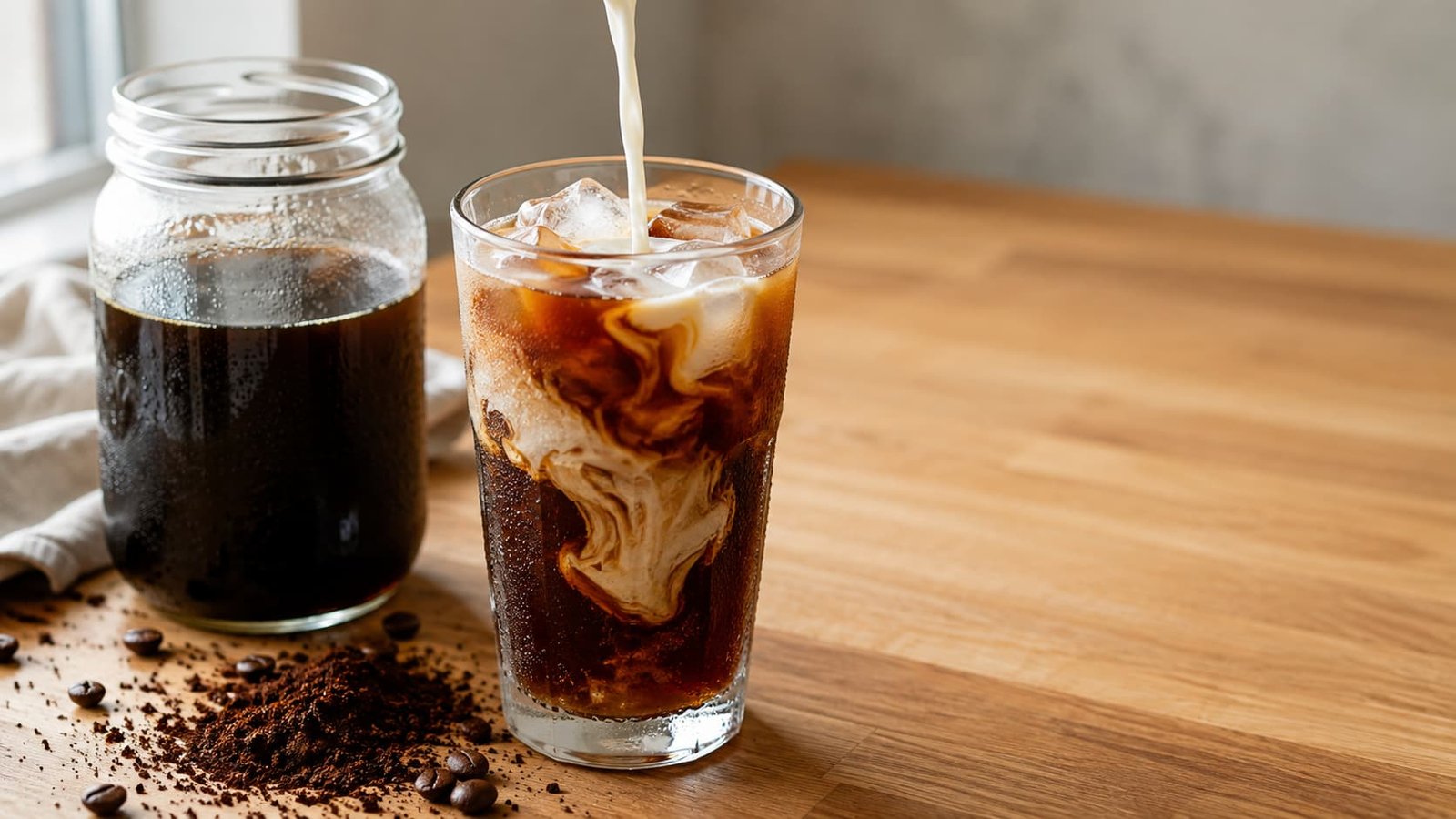
You need a jar, coarse-ground coffee, water, and the patience to leave it alone until morning. That is the entire method. What you get back is about four cups of concentrate that lives in your refrigerator for two weeks, which works out to roughly sixty cents a glass instead of five dollars.
The part most recipes get wrong is the concentration. Cold brew is not meant to be poured and drunk — brewed at the ratio I use below it comes out roughly twice as strong as hot coffee, and you dilute it in the glass. Skip that step and it tastes like syrup with a caffeine problem. Understand it and you have a jar in the fridge that makes an iced coffee in fifteen seconds.
| Active Time | Steep Time | Makes | Keeps |
|---|---|---|---|
| 10 minutes | 16 hours | 4 cups | 2 weeks |
Why This Is Worth Making at Home
The two-week shelf life is the real argument. Hot coffee is noticeably worse thirty minutes after brewing because its aromatic compounds are volatile and leaving. Cold brew never had those particular volatiles driven off by heat in the first place, so a jar of concentrate on day ten tastes essentially like it did on day two. That means one ten-minute session covers two weeks of iced coffee.
It also tastes different from iced coffee, and this trips people up. Iced coffee is hot-brewed coffee poured over ice — bright, acidic, a little thin from the melt. Cold brew is round, low-acid, chocolatey, and heavier in the mouth. If you have tried cold brew and found it flat, you probably wanted iced coffee.
One claim worth correcting, because it is repeated everywhere: cold brew is not dramatically lower in acid on a pH meter. Measured pH sits close to hot coffee, somewhere around 5.0 to 5.1. What actually changes is which compounds get extracted — cold water pulls far fewer of the bitter, sharp-tasting acids, so it tastes much less acidic. If you are avoiding coffee for stomach reasons, cold brew is genuinely gentler in practice. Just know the reason is the compound profile, not the pH.
And the cost math is not trivial. A pound of decent supermarket coffee runs about twelve dollars and yields roughly twenty glasses at this ratio.
What You’ll Need
- 100 grams coarsely ground coffee (about 1⅓ cups ground) — Use a medium or dark roast, and do not spend a lot of money here. This is my strongest opinion in this recipe: expensive light-roast single-origin beans are a poor choice for cold brew. Light roasts are denser and less soluble, and cold water fails to extract their delicate florals — you pay four times as much for a cup that tastes vaguely of nothing. A solid medium-dark supermarket bean gives you the chocolate and caramel notes cold brew does well.
- 500 grams water (about 2 cups) — This is a 1:5 ratio, which produces a concentrate. Filtered water if your tap water tastes of chlorine. Room temperature to start, not cold from the tap.
- A 1-quart jar with a lid, or any container you can cover.
- A fine-mesh sieve and a paper coffee filter or a couple of paper towels for the second filtering stage.
On the grind: coarser than you think — the texture of raw sugar or coarse breadcrumbs, with visible individual particles. Medium grind produces silt that passes the sieve and settles in the bottom of your glass, and there is no filtering it out afterward. If you are buying pre-ground, ask for a French press grind, which is close enough.
Honest swaps: a French press works as the vessel and skips the sieve stage, though the mesh is coarse enough that you still want the paper filter afterward. Decaf works identically — cold extraction does not care. And if you want a ready-to-drink brew instead of concentrate, use 1:8 (100 grams coffee to 800 grams water) and skip the dilution — but you lose the fridge-space efficiency, which is most of the appeal.
How to Make It
- Grind the coffee coarse and add it to the jar. Grinding right before you brew matters less for cold brew than for hot — the long steep extracts what it needs either way — but it still tastes better.
- Pour in the 500 grams of water and stir just enough to wet every ground, about ten seconds. You will see dry pockets floating at first; break those up and stop. Do not keep stirring. Agitation grinds the particles against each other and creates fines, and fines are what make cold brew silty.
- Cover the jar and leave it on the counter for 16 hours. Room temperature, not the refrigerator — and this is a real distinction. Extraction slows substantially in the cold, so a fridge brew needs 22 to 24 hours to reach the same strength. Sixteen hours at room temperature is the shorter path to the same result, and food safety is not a concern at this pH for that window.
- Look at it in the morning. The surface will have a raft of grounds sitting on top and the liquid beneath will be opaque and very dark, closer to soy sauce than to coffee. It smells sweet and faintly of cocoa, with none of the sharpness of hot coffee.
- First filter: pour it through the fine-mesh sieve into a bowl or large measuring cup. Go slowly and let gravity do the work.
- Do not press or squeeze the grounds. I know the instinct — there is clearly more liquid in there. What is left in the bed is the most bitter and most concentrated portion, and pressing it out will make the whole batch harsh. You lose about 40 grams of liquid. Let it go.
- Second filter: line the rinsed sieve with a paper coffee filter and pour the liquid through again. This takes 5 to 8 minutes and it is worth every second — the first pass removes the grounds, the second removes the suspended fines that would otherwise settle into a muddy layer at the bottom of your glass. Rinse the paper filter with water first or you will taste the paper.
- Pour the finished concentrate into a clean jar, lid it, and refrigerate. You should have about 460 grams — roughly 2 cups of concentrate, or 4 cups of finished coffee.
- To serve: fill a glass with ice, add equal parts concentrate and water or milk. Start at 1:1 and adjust from there. Taste it before you add anything else — you want to know what your batch actually tastes like at drinking strength.
Tips That Actually Make a Difference
Weigh the coffee if you own a scale. Coarse-ground coffee varies enormously by volume — a cup of very coarse grounds weighs noticeably less than a cup of medium grounds, so a volume measurement gives you a different strength every time. This is the main reason people’s cold brew is inconsistent batch to batch.
Use room-temperature water to start, not cold. The difference over 16 hours is small but real: cold water extracts more slowly for the first few hours, and starting at room temperature gets the extraction moving.
Label the jar with the date. Two weeks is a long window and cold brew gives you almost no sensory warning as it fades — it does not sour or smell off, it just gradually loses dimension. Writing the date on masking tape solves the guessing.
Make the ice out of diluted cold brew. Fill an ice cube tray with concentrate cut 1:1 with water and freeze it. Those cubes keep your glass from turning to watery brown nothing by the last third, which is the most annoying flaw in every iced coffee.
Do not chase a clearer brew with a third filter. Past two stages you start removing the oils that give cold brew its body, and the result tastes thin. Two passes is the right number.
Mistakes to Watch Out For
Drinking it undiluted. The most common mistake, and it makes people think they dislike cold brew. At 1:5 this concentrate carries roughly twice the caffeine of an equal volume of hot coffee. Dilute it.
Grinding too fine. A medium or fine grind over 16 hours gives you a gritty, over-extracted brew that tastes bitter despite never touching heat. If you already made this mistake, the paper filter stage will rescue some of the texture but not the bitterness.
Steeping for 24 hours or more at room temperature. Past about 20 hours the brew picks up a woody, papery flavor that no amount of milk hides. Cold brew is forgiving on the short end and unforgiving on the long end — 14 hours is fine, 26 is not.
Squeezing the grounds. Covered above, and I am repeating it because it is such a natural instinct. It ruins the batch, not just the last few tablespoons.
Storing it in a metal container. Cold brew is acidic enough to react with reactive metals over two weeks and pick up a distinctly metallic edge. Glass, and preferably a jar you can seal properly — an open pitcher in the fridge picks up refrigerator odors within about four days.
Reusing the grounds for a second batch. There is nothing left worth extracting. The second batch tastes like brown water, and I have tried it so you do not have to.
Easy Ways to Change It Up
Cinnamon and cardamom. Add a 2-inch cinnamon stick and 4 lightly crushed cardamom pods to the jar at the start. They infuse over the same 16 hours and the result is warm and slightly sweet without any sugar. Use whole spices only — ground spices pass straight through both filters and turn the concentrate gritty.
Vietnamese-style, with sweetened condensed milk. Two tablespoons of condensed milk in the bottom of the glass, then ice, then concentrate. Stir until the milk streaks up through the coffee. Skip the water entirely here — the condensed milk provides the dilution. This is the version I make when I want dessert.
Salted maple. Stir 1 tablespoon of maple syrup and a pinch of flaky salt into the glass before the ice. Salt suppresses bitterness perception, so this works particularly well on a batch that came out slightly stronger than you meant.
A hot cup from cold brew concentrate. Cut the concentrate 1:1 with hot water — not boiling, around 180°F. It gives you a low-acid hot coffee that is genuinely pleasant, though it lacks the aromatic lift of a fresh hot brew. Useful in winter when the jar is already made. For a proper hot cup, brewing it hot is the better route.
Decaf for the evening. Make a second smaller batch with decaf and keep both jars. Cold brew is easy to drink at 9pm and easy to regret at 2am.
What to Drink It With
Cold brew’s chocolate and caramel notes sit next to breakfast pastry better than hot coffee does — its low perceived acidity means it does not fight buttery or sweet things. A croissant, a slice of banana bread, or an almond pastry all work.
It is also the coffee I would pair with anything spicy at brunch. The cold and the heavy body handle chili in a way that hot acidic coffee does not, so it holds up beside huevos rancheros or a breakfast taco.
With milk, whole dairy is my preference — the fat rounds out the concentrate and the two combine into something closer to a milkshake in texture. Oat milk is the best non-dairy option here because its own starch adds body; almond milk is thin enough that the coffee dominates and the drink separates in the glass within a few minutes.
Skip sugar in the glass and use a simple syrup instead if you sweeten. Granulated sugar does not dissolve in cold liquid — it sits at the bottom and the last sip is grit.
Storing It
Two weeks refrigerated for the concentrate, in a sealed glass jar. That is the honest number, and it is longer than most sources claim because the absence of heat during brewing means far fewer oxidized compounds to go stale.
Once you dilute it, drink it within a week. Diluted cold brew fades faster — there is simply less concentration of everything, so the loss is more noticeable.
It does not go dangerous so much as dull. By week three the chocolate notes have flattened and what is left tastes generically dark and slightly cardboardy. Nothing about it will smell wrong, which is exactly why the date on the jar matters.
Freezing works well and is underused. Freeze concentrate in an ice cube tray, then bag the cubes — they hold their character for three months and you can drop two into a glass of milk for an instant iced latte. This is the best answer if you brewed more than you will drink in two weeks.
Approximate Nutrition Per Serving
| Calories | Protein | Carbs | Fat | Fiber |
|---|---|---|---|---|
| 5 kcal | 0.5 g | 1 g | 0 g | 0 g |
These numbers are estimates provided for informational purposes only, for one 8-ounce glass of diluted cold brew, black. Milk, condensed milk, syrup, and other additions change them substantially.
Final Thoughts
What makes this worth doing is not that cold brew is trendy. It is that ten minutes of work on a Sunday night means that for the next two weeks, iced coffee costs you the time it takes to fill a glass with ice. That is a genuinely different relationship with your morning.
Start a jar tonight with whatever medium-roast bag is already in your cupboard. Taste it at 1:1 in the morning before you decide anything about the ratio.